HUMAN EVOLUTION × TECHNOLOGY
The Oldest Cave Art
~51,000 years ago
Phanerozoic · Cenozoic · Quaternary · Pleistocene · Late Pleistocene
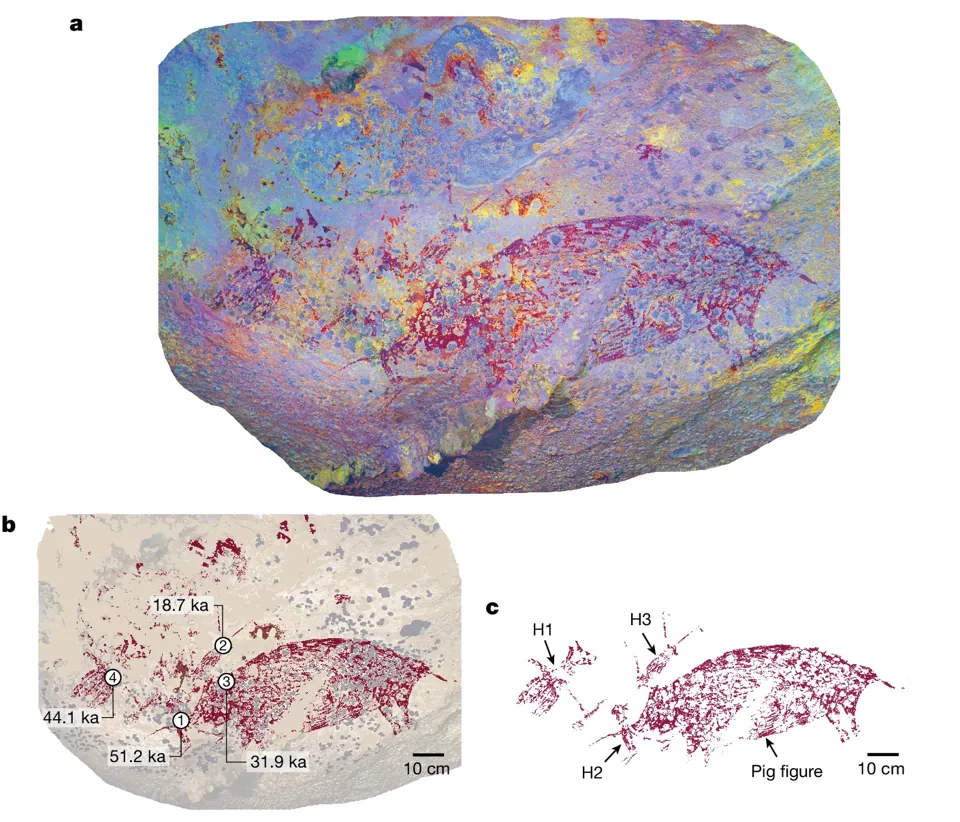
The oldest known narrative scene is a painting on a cave wall in Sulawesi, Indonesia, that shows three human-like figures arranged around a wild pig and is at least 51,200 years old.
Cave art is the making of images on the walls of caves, and its oldest known narrative scene is in Sulawesi, in Indonesia. Oktaviana and colleagues (2024) dated the scene to at least 51,200 years ago. Three human-like figures are arranged around a wild pig in such a way as to interact with it. This interaction distinguishes a scene from figures simply placed side by side. Hand stencils and pictures of animals of comparable age are attested from Indonesia to the Iberian peninsula, that is, Spain and Portugal. A hand stencil is made by blowing pigment around a hand held against the wall.
Why it matters
To paint an animal that is not there, the painter must picture something absent. To paint several figures acting together, the painter must also condense an event, with a before and an after, into a single image that another person is meant to interpret. The Sulawesi scene is the first durable trace of an intellectual operation of this kind.
Dating & uncertaintyDisputed
The Sulawesi scene is dated by the uranium-thorium method, which measures the decay of uranium into thorium. The method is applied to deposits of calcite, a mineral left by water, that overlie the paintings, and so gives a minimum age for the figure beneath. In the Iberian peninsula, Hoffmann and colleagues (2018) attributed parietal art, the art of cave walls, to Neanderthals. They obtained ages greater than 64,800 years by the same method, and other researchers contest these ages. If these ages hold, painting in Europe precedes the arrival of modern humans.
Earth history as one day
23:59:59.03974 ms before midnight
if Earth’s 4.54 billion years were compressed into a single day