EXTINCTIONS
The Megafauna Extinction
~50,000 to 4,000 years ago
Phanerozoic · Cenozoic · Quaternary · Pleistocene · Late Pleistocene
The large land mammals, mammoths, giant ground sloths and marsupial lions among them, disappeared continent after continent between about 50,000 and 4,000 years ago, each time shortly after humans arrived.
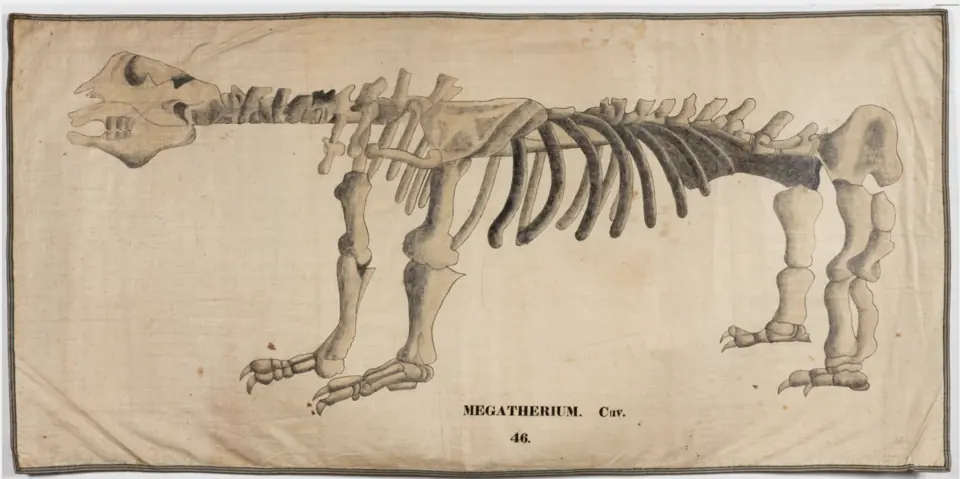
The megafauna extinction is the disappearance of the megafauna, the large land mammals such as mammoths, giant ground sloths and marsupial lions. They disappeared continent after continent, each time shortly after the arrival of humans: in Australia about forty-five thousand years ago, and in the Americas about thirteen thousand years ago. A few island populations persisted far longer, such as the mammoths of Wrangel Island, which survived until four thousand years ago. The extinction is size-selective: the heavier a species, the more likely it was to disappear. No climatic mechanism predicts this pattern directly. Sandom and colleagues (2014) analysed all the extinct large mammals worldwide. They establish that the severity of the losses follows the distribution of hominin presence. Hominins are humans and their extinct relatives. The severity bears at most a weak relation to climate, and this relation is confined to Eurasia.
Why it matters
The megafauna extinction is the first wave of extinctions in which the human species is the principal factor implicated. The extinction also explains why the largest animals are missing from landscapes that people regard as natural. Every continent except Africa lost most of its large animals, and present generations consider what remains to be normal.
Dating & uncertainty
The losses took place at different dates on different continents, and each followed the arrival of humans: about 45,000 years ago in Australia and about 13,000 years ago in the Americas. Island populations such as the Wrangel Island mammoths survived until about 4,000 years ago. The quality of the dating varies considerably between regions. Researchers still debate the relative weight of hunting and of climate.
Earth history as one day
23:59:59.05952 ms before midnight
if Earth’s 4.54 billion years were compressed into a single day