SUBSISTENCE
The Domestication of Rice
~9,400 years ago
Neolithic · Neolithic · Holocene · Greenlandian
Rice was domesticated in the lower Yangtze valley about 9,400 years ago, through the unintended selection of plants whose grain stayed on the stalk.
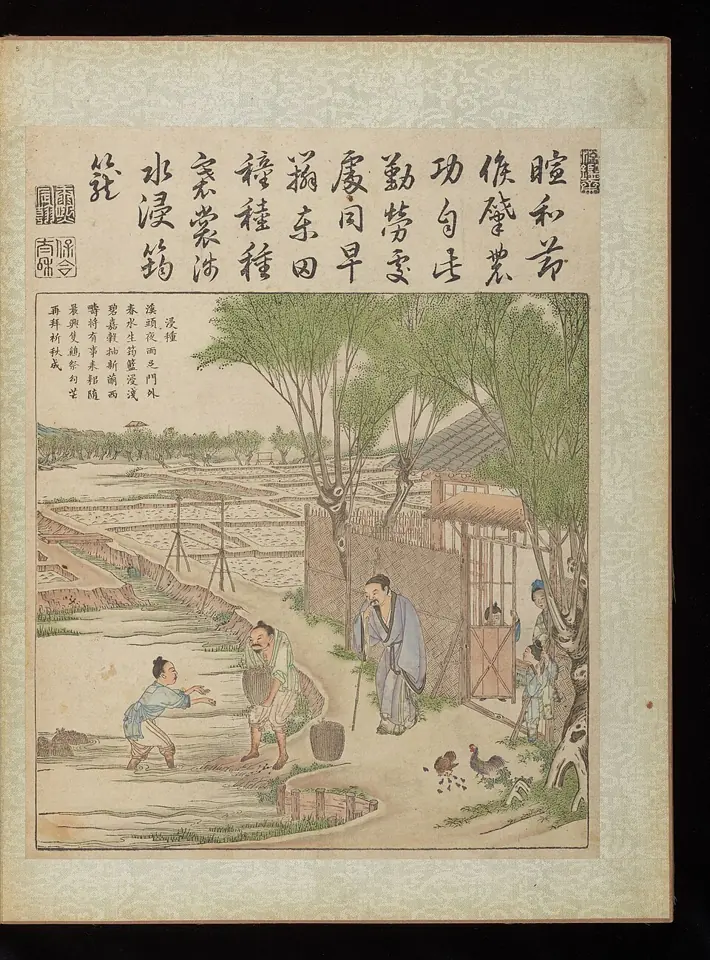
The domestication of Asian rice, Oryza sativa, from its wild ancestor Oryza rufipogon, took place in the lower Yangtze valley through unintentional selection: plants whose grain remained on the stalk, unfit for natural dispersal, were precisely those that harvesting removed and sowing perpetuated. Rice cells deposit silica casts, or phytoliths, amenable to direct dating: those from Shangshan are dated to about 9,400 years and present a morphology closer to domesticated than to wild rice. Neighbouring sites allow the process to be followed grain by grain, at the spikelet base, where the mode of detachment can be read: a wild grain separates at a smooth, preformed break point, whereas a retained grain must be torn off and leaves an irregular fracture. The three states, wild, intermediate and non-shattering, coexist for several millennia.
Why it matters
The plant today feeds about a third of the world's population. The case further documents the real duration of a domestication: the gathering of wild rice is attested very early in the region, cultivation precedes the appearance of domestic characters by several millennia, and the irrigated cultivation that results binds populations to a determined calendar and land management.
Dating & uncertainty
Direct dating of the phytoliths gives about 9,400 years at Shangshan, the value retained here. A phytolith sequence published in 2024 in the same region places domestication around 11,000 years, at the end of a longer process: gathering of wild rice around 24,000 years, cultivation around 13,000 years while the grain still presented wild characters. On both readings, gathering and then cultivation considerably precede full domestication.
Our species’ history as one day
23:17:0142 min 58 s before midnight
if the 315,000 years of Homo sapiens were compressed into a single day