SOCIETY
The Natufian: Settled Before Farming
~14,500 years ago
Palaeolithic · Upper Palaeolithic · Last glacial
In the Levant, from about 15,000 years ago, Natufian communities lived year-round in stone hamlets, settled before they farmed.
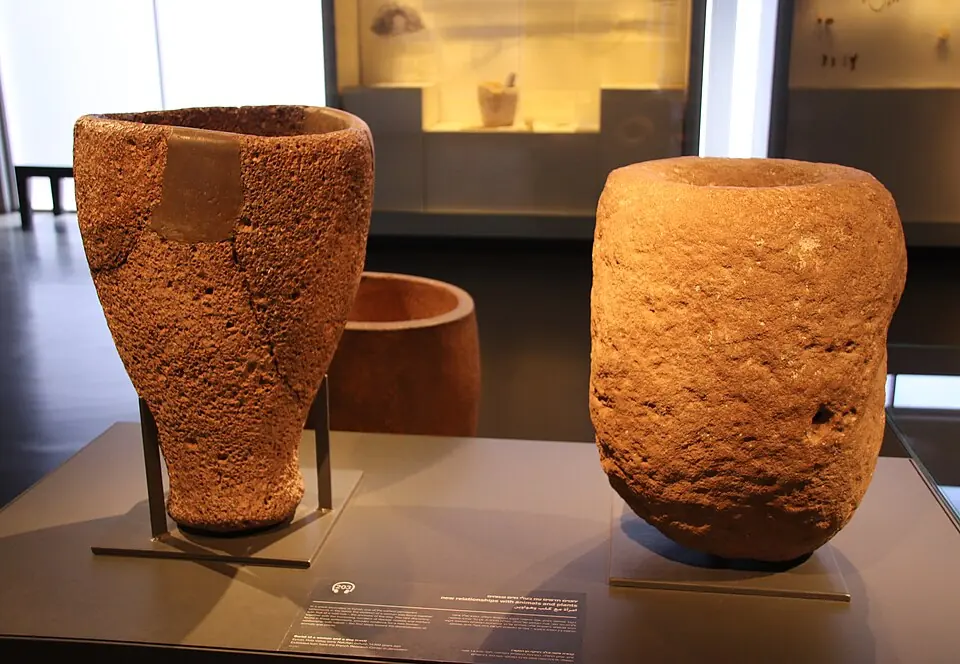
The Natufian is an archaeological culture of the Levant, dated to about 15,000 to 11,700 years before present, characterised by the appearance of permanent occupation prior to agriculture. Its communities occupied year-round hamlets of round stone houses, equipped with heavy mortars and storage structures, and associated with cemeteries and with domestic refuse accumulated in place. No plant was then domesticated: wild cereals, wetland tubers, gazelle and fish sustained this sedentism, which some communities maintained through the cold episode of the Younger Dryas.
Why it matters
Sedentism here precedes agricultural production, which inverts the long-accepted sequence: the village, the adjoining cemetery and attachment to a determined place are the work of hunter-gatherers, agriculture developing subsequently within that frame. The associated material conditions, property, density of settlement and storage of surplus, appear in the same way before it.
Dating & uncertainty
The Natufian extends from about 15,000 to 11,700 years before present; the date retained here corresponds to the appearance of the first sedentary hamlets. Year-round occupation is not directly observable and is inferred from two indicators. The first is faunal: commensal species, house mouse and sparrow in particular, persist only where food reserves are available throughout the year, and their presence in refuse indicates continuous occupation. The second is seasonal: shells, teeth and fish bones carry growth bands indicating the season of capture, so that a site where every season is represented was occupied without interruption. Results vary from valley to valley.
Our species’ history as one day
22:53:421 h 6 min before midnight
if the 315,000 years of Homo sapiens were compressed into a single day