ENVIRONMENT × PEOPLING
Doggerland: the Drowned Land
~8,150 years ago
Neolithic · Neolithic · Holocene · Northgrippian
Doggerland, a plain of rivers and marshes now under the North Sea, was submerged about 8,150 years ago as the ice sheets melted and the sea rose.
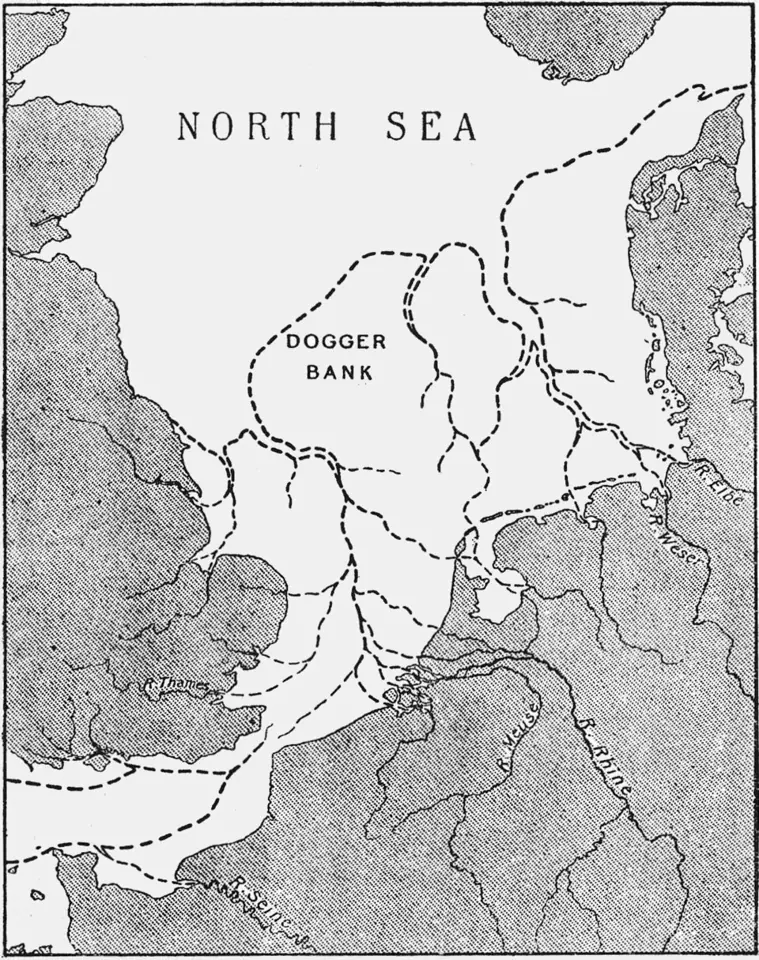
Doggerland is a region now submerged beneath the North Sea, between Great Britain and Denmark, whose name derives from the Dogger Bank that forms its residual relief. A plain of rivers, marshes and woodland, it was frequented by Mesolithic populations for several millennia while the melting of the ice sheets progressively raised sea level. About 8,150 years ago, a large submarine landslide off Norway, known as the Storegga slide, caused a tsunami over the remaining land. The respective part played by that event and by marine transgression in the disappearance of the territory remains debated.
Why it matters
A substantial part of the territories occupied in the Palaeolithic and Mesolithic now lies under water, notably the coastlines followed during the departures from Africa and the Sunda and Bering shelves. Their study rests on reflection seismics, developed for petroleum prospecting: sound waves are emitted towards the sea floor, each buried layer returns part of them, and the delay of the echoes allows the underlying relief to be reconstructed, including former river valleys; coring then supplies the peat and pollen that characterise the vegetation. Doggerland thus documents a modification of the map on a timescale perceptible to the populations concerned.
Dating & uncertainty
The Storegga slide propagated a tsunami across the North Sea about 8,150 years ago, within the same chronological window as the cold episode known as the 8.2 ka event. Its role in the disappearance of the territory is debated: recent data from the southern North Sea indicate effects attenuated by woodland cover and relief, and several authors consider that sea-level rise had already submerged most of it, the last islands persisting for some centuries.
Our species’ history as one day
23:22:4437 min 15 s before midnight
if the 315,000 years of Homo sapiens were compressed into a single day