ART × TECHNOLOGY
Blombos: an Ochre Workshop
~100,000 years ago
Palaeolithic · Middle Stone Age · Last glacial
At Blombos Cave, in South Africa, a workshop for preparing ochre pigment was preserved in place about 100,000 years ago.
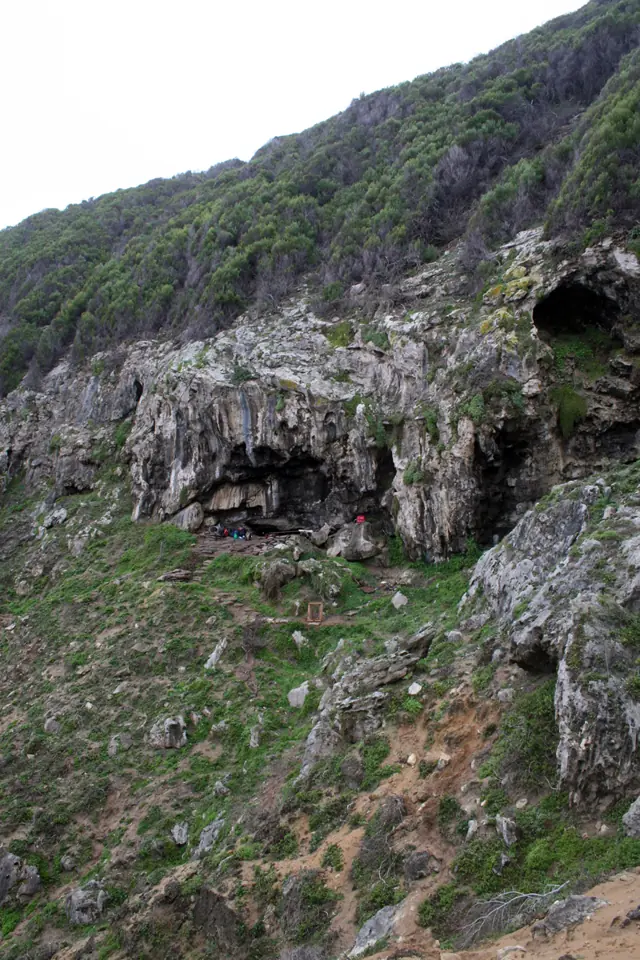
Blombos Cave, on the southern Cape coast of South Africa, yielded in 2011 two abalone shells containing a dried mixture rich in ochre, associated with the grindstones, hammerstones, bone fragments and charcoal making up the rest of the equipment needed for its preparation. The assemblage is interpreted as a pigment workshop preserved in place, dated to about 100,000 years. It is the association of the objects that grounds the interpretation, two isolated shells establishing nothing, whereas shells found among the tools required to grind and mix a pigment constitute a work station. The same site has produced blocks of ochre engraved with cross-hatched motifs over a span of 25,000 years, as well as a silcrete flake bearing a drawing traced with an ochre crayon around 73,000 years ago, published in 2018.
Why it matters
Preparing such a mixture implies a planned sequence: collecting several materials, combining them to a defined composition, and keeping the product in containers for deferred use. Its purpose, treatment of skin or hides, or symbolic use, is undetermined, and recent work also documents the use of ochre as a retoucher in stone knapping. The site thus associates technical and possibly symbolic functions without separating them.
Dating & uncertainty
The two shells and the associated tools come from a level dated to about 100,000 years by optically stimulated luminescence, a method that dates the surrounding sand grains rather than the objects themselves. The engraved ochres from the site span roughly 100,000 to 75,000 years, and the drawn silcrete flake is dated to about 73,000 years: the practice is a durable one.
Our species’ history as one day
16:22:517 h 37 min before midnight
if the 315,000 years of Homo sapiens were compressed into a single day