ART
Did Neanderthals Make Cave Art?
~64,800 years ago
Palaeolithic · Middle Stone Age · Last glacial
Red markings in three Spanish caves are older than 64,800 years, which would make Neanderthals the authors of the oldest cave art.
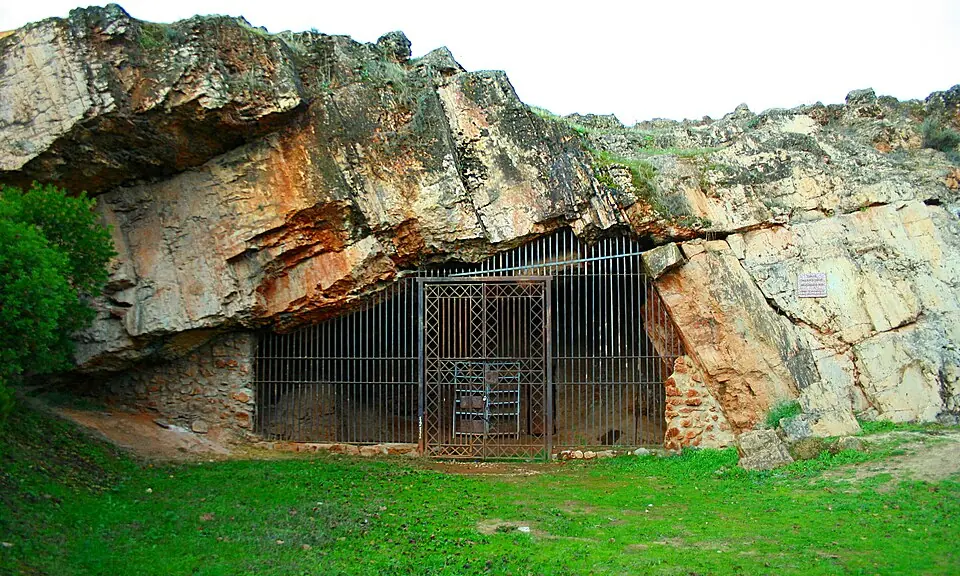
Three Spanish caves, La Pasiega, Maltravieso and Ardales, carry red markings, respectively a ladder-shaped motif, a hand stencil and painted cave formations, covered by thin crusts of calcite. Uranium-thorium dating of those crusts, published in 2018, gave minimum ages greater than 64,800 years, at least twenty millennia before the attested presence of Homo sapiens in Europe. If these results are retained, the makers of the markings were Neanderthals.
Why it matters
What is at stake is not ornamentation but cognitive capacity: executing an image on a wall implies a mental representation and a shared system of signs. Attributing it to Neanderthals would remove the last clearly drawn behavioural boundary between that lineage and Homo sapiens, which explains why discussion has concentrated on the reliability of the dating method.
Dating & uncertaintyDisputed
The uranium-thorium dates are minimum ages, measured on carbonate crusts formed over the markings and not on the pigment. The method assumes that the crust behaved as a closed system, retaining its initial uranium while thorium accumulated within it by decay. Water circulating through the rock breaks that condition: leaching of uranium leaves a relative excess of thorium and the calculated age comes out too old. A comment published in 2018 reads the same data as compatible with an age near 47,000 years, and a study conducted in 2020 at Nerja established the open character of such crusts. On that second reading, attribution to Homo sapiens becomes possible again.
Our species’ history as one day
19:03:464 h 56 min before midnight
if the 315,000 years of Homo sapiens were compressed into a single day