LIFE × EVOLUTION
The First Eyes
~515 million years ago
Phanerozoic · Paleozoic · Cambrian
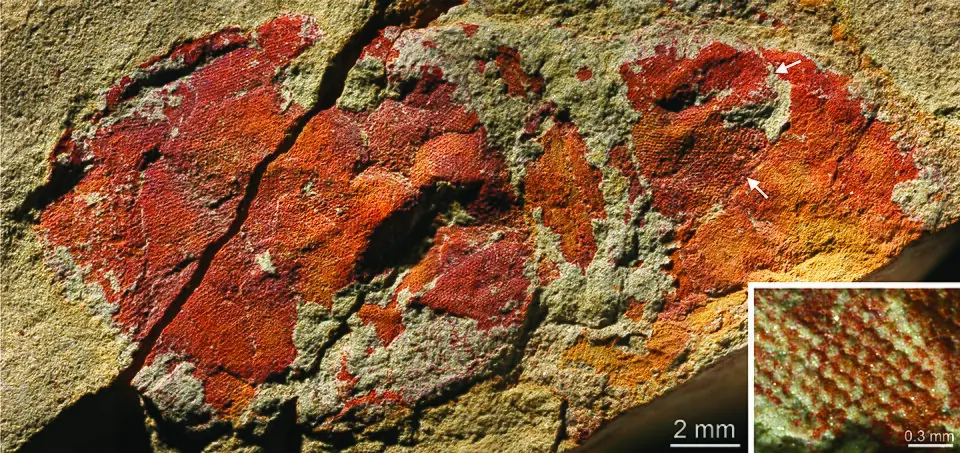
The oldest eyes preserved in detail are fossils about 515 million years old from a shale, a rock formed from hardened mud, in South Australia, and one pair has at least sixteen thousand lenses in each eye.
A compound eye is made of many small lenses side by side, as in insects today. One shale in South Australia has yielded two kinds of fossil eye. One pair belonged to Anomalocaris, the largest predator of the Cambrian seas. These eyes were two to three centimetres across, each had at least sixteen thousand hexagonal lenses, and they saw as sharply as the sharpest compound eyes of living animals. The other kind belonged to a smaller arthropod, an animal with a jointed body and legs. It has more than three thousand lenses, and in one patch the lenses are wider. Such a patch is called a bright zone: larger lenses gather more light but show less detail, and animals that hunt in dim water use this arrangement.
Why it matters
What is new about 515 million years ago is the lens, since sensitivity to light is older. A lens turns the detection of light into an image. An animal that forms images can distinguish another animal at a distance, and concealment, protection and speed then become necessary. This makes vision a plausible factor in the Cambrian explosion, the appearance of most major animal groups during the Cambrian.
Dating & uncertainty
About 515 million years is the age of the oldest eyes preserved in enough detail to show their lenses. Light-sensitive organs are certainly older, and probably Precambrian, that is, older than the Cambrian period. The South Australian shale therefore gives a date for the lens and not for the perception of light.
Earth history as one day
21:16:392 h 43 min before midnight
if Earth’s 4.54 billion years were compressed into a single day