LIFE × EVOLUTION
The First Vertebrates
~518 million years ago
Phanerozoic · Paleozoic · Cambrian
The earliest known vertebrates were swimming animals a few centimetres long, with a notochord, a pair of camera eyes and zigzag muscle blocks, that lived about 518 million years ago.
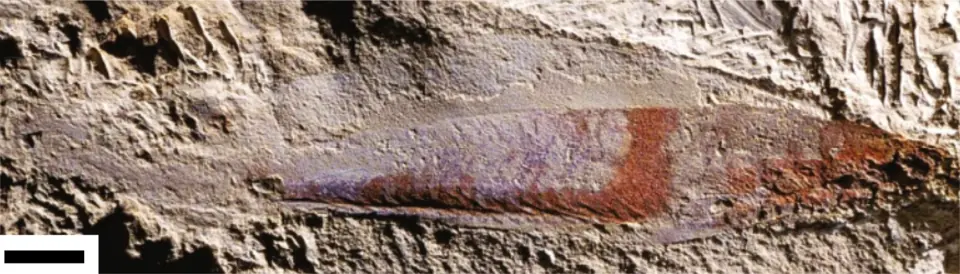
The earliest known vertebrates were small swimming animals a few centimetres long. They had a notochord, a stiffening rod that runs the length of the body and against which muscles pull. They had a pair of camera eyes, each with a lens that forms an image, and paired nasal sacs, pouches for the sense of smell. Their muscle blocks, or myomeres, were arranged in zigzag. They had no jaws, no bone and no developed fins. Two forms come from South China and one from the Burgess Shale, a fossil deposit in North America. This indicates that the group was already distributed across the oceans of the world.
Why it matters
Fishes, dinosaurs, cetaceans such as whales and the readers of this page are variations on this animal. These organisms already possessed a sheet of migrating cells, and this sheet of cells, rather than the backbone, made that variation possible. In every vertebrate it builds the head, and later the jaws.
Dating & uncertainty
A notochord, paired eyes, nasal sacs and muscle blocks in zigzag, shaped like a W, are visible in these soft-bodied fossils, a few centimetres long, from South China and the Burgess Shale. Researchers argue the position of each form: already a craniate, an animal with a skull, or still a stem chordate, on an early branch of the chordates, the group that includes vertebrates.
Earth history as one day
21:15:422 h 44 min before midnight
if Earth’s 4.54 billion years were compressed into a single day