GENETICS
The Genetic Code
1961 to 1966 CE
Phanerozoic · Cenozoic · Quaternary · Holocene · Meghalayan
The genetic code, solved between 1961 and 1966, is the rule that assigns one amino acid, a building block of proteins, to each group of three bases, almost identically in every living thing.
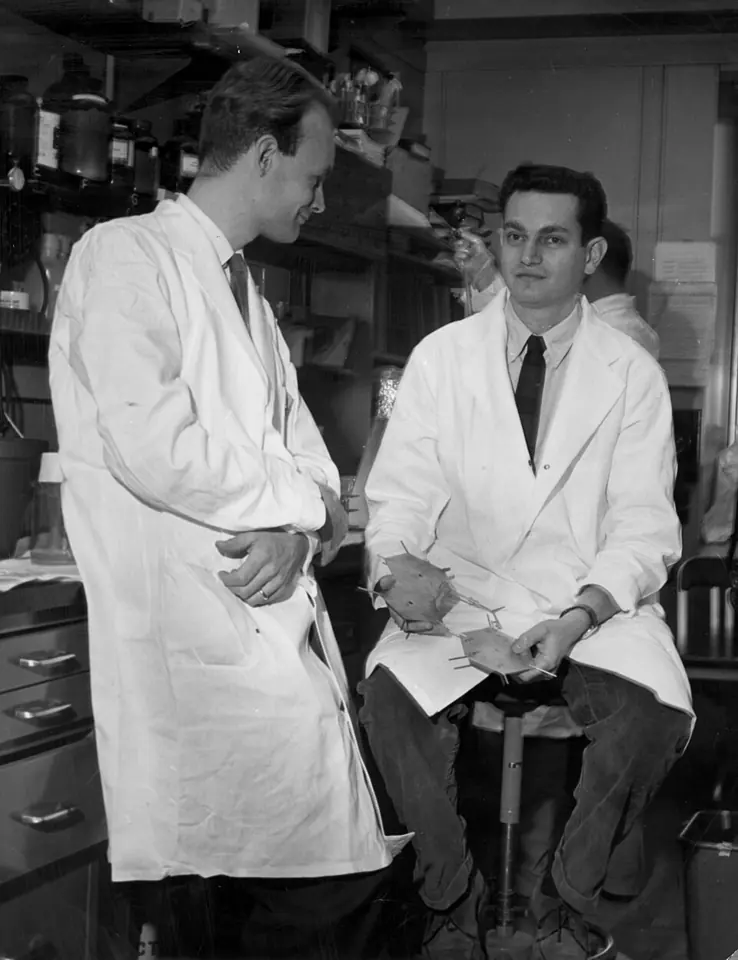
The genetic code is the rule that assigns one amino acid to each group of three bases. Bases are the chemical units strung along DNA and RNA, and a group of three is a codon. The assignment is very nearly identical in every living thing. Researchers solved the code by supplying synthetic RNA to cell extracts, the contents of broken cells, and identifying the protein produced. Nirenberg and Matthaei (1961) used a strand of pure uracil, one of the bases, which yielded a protein of pure phenylalanine, one of the amino acids. That result established the first codon. The remaining sixty-three codons took five more years.
Why it matters
A code so nearly identical in all living organisms is one of the strongest arguments for their descent from a single population of cells. The assignments are arbitrary: no chemical constraint requires a given group of three bases to designate a given amino acid. Finding the same arbitrary choices in a bacterium and in a human being therefore points to inheritance, not to coincidence.
Dating & uncertainty
The date displayed is an interval. Researchers assigned the first codon in 1961 and established the remaining codons in two stages up to 1966.
Earth history as one day
23:59:59.99881.2 ms before midnight
if Earth’s 4.54 billion years were compressed into a single day