GENETICS × TECHNOLOGY
The Structure of DNA
1953 CE
Phanerozoic · Cenozoic · Quaternary · Holocene · Meghalayan
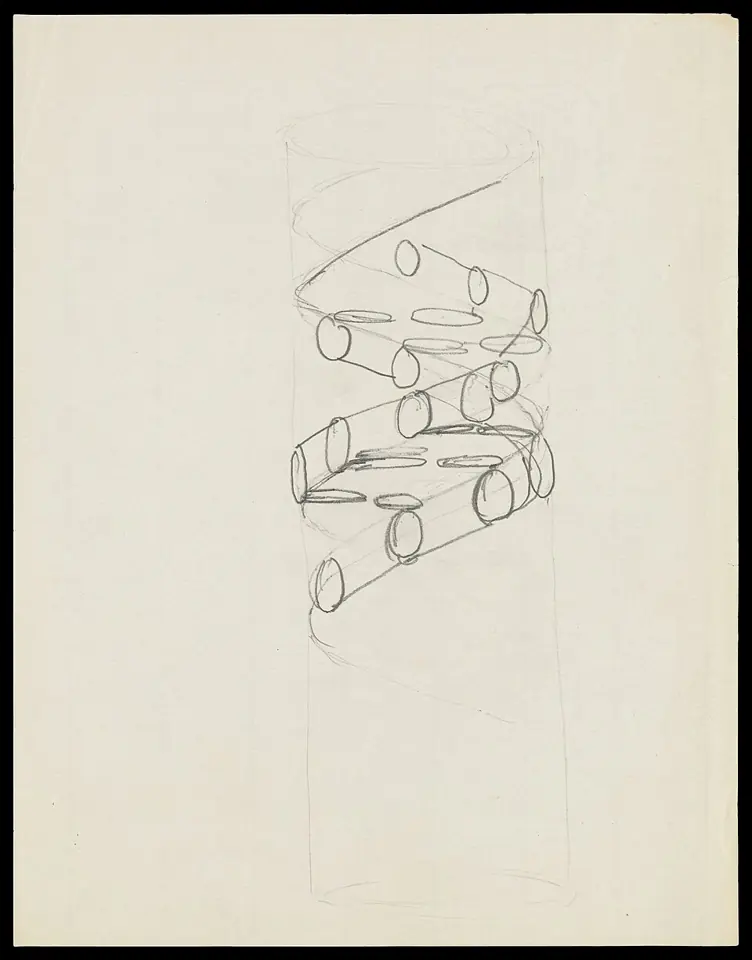
The double helix, the structure of DNA established by three papers published side by side in Nature in April 1953, is two paired strands whose arrangement explains how the molecule is copied.
The double helix is the structure of DNA, two strands wound around each other. Three papers published side by side in Nature in April 1953 established it: the model of Watson and Crick, the X-ray data of Wilkins and colleagues, and the diffraction photographs of Franklin and Gosling, images of X-rays scattered by DNA. The structure explains how DNA is copied. Each strand is a chain of bases, the units whose order is the sequence. Each base pairs with one other and no other, a rule called base complementarity, so each strand specifies the sequence of its partner. Separating the two strands leaves two templates, each a model on which a partner can be rebuilt.
Why it matters
Heredity, the passing of traits from parents to offspring, has existed since the appearance of life, but its mechanism was unknown. The double helix supplied that mechanism. Later techniques on this timeline start from an understanding of how the double helix is copied: the reading of a genome, which is the whole DNA of an organism, the copying of DNA at will and the editing of a gene.
Earth history as one day
23:59:59.99861.4 ms before midnight
if Earth’s 4.54 billion years were compressed into a single day