LIFE
The Francevillian Biota
~2.1 billion years ago (biological origin disputed)
Proterozoic · Paleoproterozoic · Rhyacian
The Francevillian biota is a set of flattened sheets up to twelve centimetres across, preserved in rocks about 2.1 billion years old in Gabon, and whether they were ever alive is disputed.
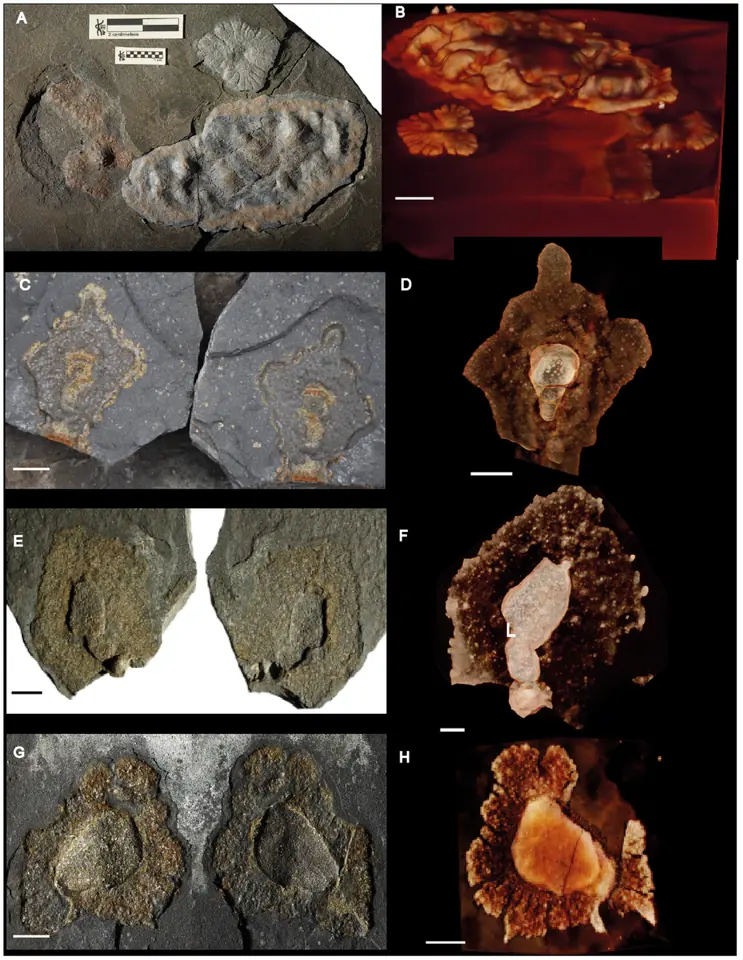
The Francevillian biota is a group of forms found in black shales, dark rocks formed from mud, in the Franceville basin in Gabon. The forms are flattened flexible sheets up to twelve centimetres across, and most have a radiating internal pattern. They are preserved in pyrite, a mineral made of iron and sulfur. Researchers agree on the rocks and on their age, just after the first oxygenation of the atmosphere, and disagree on what the forms are. If the forms are organisms, they coordinated their growth across many cells, and would be by a wide margin the oldest known multicellular organisms. If the forms are not organisms, mineral chemistry produced forms that closely resemble bodies.
Why it matters
If the forms are organisms, complex life with coordinated growth existed a billion and a half years before the Cambrian explosion, the rapid appearance of most major animal groups in the fossil record. A gap of this size explains why the biological interpretation is contested.
Dating & uncertaintyDisputed
El Albani and colleagues (2010) interpret the pyritised forms, centimetre-scale forms turned to pyrite in the Francevillian rocks of Gabon, as colonies of organisms that grew in a coordinated way. That is well before macroscopic life, meaning life visible to the naked eye, diversifies elsewhere in the fossil record. The rocks and their age are established. Whether the forms are bodies or mineral growths remains open. The oxygen around the forms is inferred from geochemistry, the chemical composition of the rocks, and may have been local rather than global. Microbial mats, layers of microbes covering the sediment, are found with the forms: the mats could have produced the oxygen, and probably contributed to preserving the forms.
Earth history as one day
12:53:5511 h 6 min before midnight
if Earth’s 4.54 billion years were compressed into a single day