LIFE × EVOLUTION
Acritarchs: the Spiny Microfossils
~1.6 to 1.0 billion years ago
Proterozoic · Mesoproterozoic · Calymmian
Acritarchs are microscopic fossil spheres with a resistant organic wall, some smooth and some spiny, abundant from 1.6 to 1.0 billion years ago, whose producers are unknown.
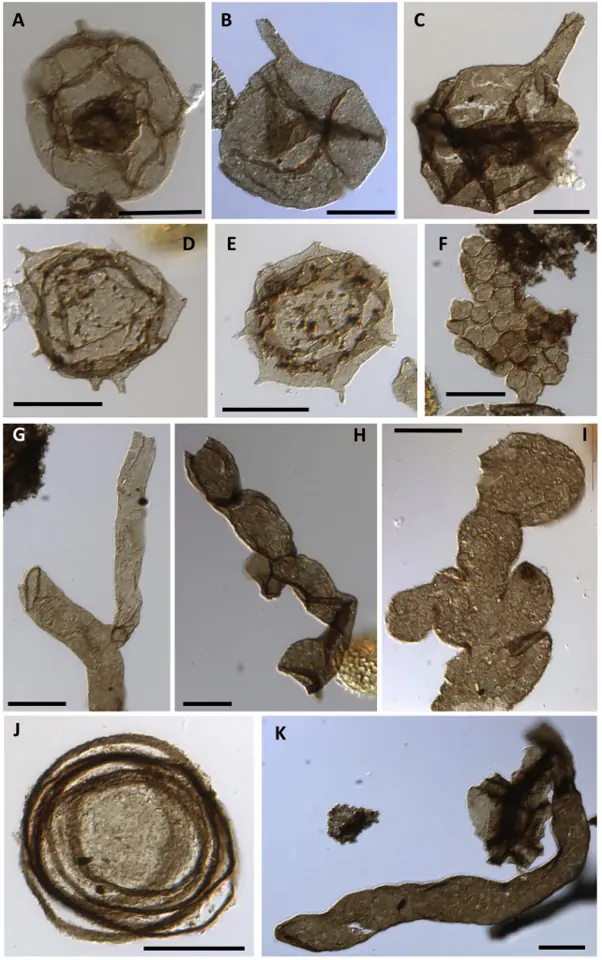
Acritarchs are organic-walled microfossils of unknown biological affinity, which means that no one knows which group of organisms produced them. They are microscopic spheres with a resistant wall. Some are smooth, some ornamented, and some bear spines. Many are pierced by a single circular opening, called a pylome, through which the cell inside left. From roughly 1.6 to 1.0 billion years ago, acritarchs are almost the entire fossil record of complex cells, the cells with a nucleus, called eukaryotic. Beghin and colleagues (2017) described one assemblage from Mauritania thoroughly, an assemblage being the set of fossils found together in one deposit. Of its forty-eight forms, eleven can be called eukaryotic with confidence. Of the thirty-seven others, a few are possible eukaryotes, a few are probable prokaryotes, cells without a nucleus such as bacteria, and most remain undetermined.
Why it matters
The interval from 1.6 to 1.0 billion years ago is reputed poor in events, and acritarchs are a principal reason: its rocks contain little else to observe. Each newly described assemblage nonetheless raises the number of identifiable eukaryotes. The interval may therefore look poor because few of its fossils have been identified, rather than because little happened to life.
Dating & uncertainty
Acritarch designates a form and not a lineage, that is, a line of descent. The word covers organic-walled cysts, resistant envelopes that once enclosed a cell, whose producers are unknown. Ornamented and spined acritarchs are accepted as eukaryotic, because no known prokaryote builds a wall of that kind. Researchers generally cannot assign a given cyst to a lineage.
Earth history as one day
15:32:308 h 27 min before midnight
if Earth’s 4.54 billion years were compressed into a single day