PEOPLING
The White Sands Footprints
~23,000 to 21,000 years ago
Palaeolithic · Upper Palaeolithic · Last glacial · Last Glacial Maximum
Human footprints in New Mexico, dated to 23,000 to 21,000 years ago, put people in the Americas at the height of the last glaciation.
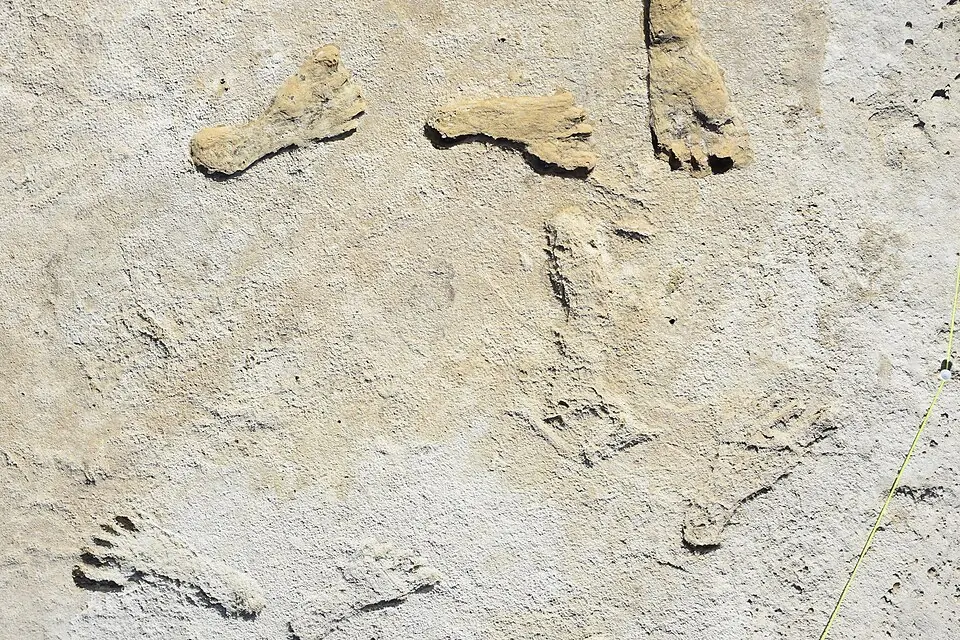
White Sands National Park, in New Mexico, preserves in the sediments of the former Lake Otero, now dry, a set of human footprints many of which were left by children and adolescents. Their dating, between 23,000 and 21,000 years, places them at the height of the last glaciation, a period during which the ice sheets closed the routes from Asia. They therefore establish a human presence in the interior of the American continent prior to the opening of the corridors, and are associated with tracks of mammoths and giant ground sloths.
Why it matters
The site advances by several millennia the date of the peopling of the last inhabited continents, and predates every recognised archaeological culture in the Americas. It requires either an arrival before the closure of the continental routes or a coastal itinerary. A footprint further constitutes a type of document distinct from an artefact, in that it records an individual, their stature and their gait at a given moment.
Dating & uncertainty
Radiocarbon applied to aquatic seeds bracketing the footprints gave 23,000 to 21,000 years, a result contested on grounds of an old-carbon effect. The objection concerns a real phenomenon: an aquatic plant draws its carbon from the lake water, which may contain dissolved carbon from ancient rock devoid of radiocarbon, artificially ageing the sample. The response consisted in dating materials supplied by the atmosphere. Radiocarbon on terrestrial pollen from the same levels, luminescence on the sediments and the stratigraphy of the lake yielded concordant results.
Our species’ history as one day
22:19:251 h 41 min before midnight
if the 315,000 years of Homo sapiens were compressed into a single day