ENVIRONMENT
The Last Glacial Maximum
~26,500 to 19,000 years ago
Palaeolithic · Upper Palaeolithic · Last glacial · Last Glacial Maximum
Between about 26,500 and 19,000 years ago, the ice sheets reached their greatest extent and the sea stood 120 to 140 metres below today's level.
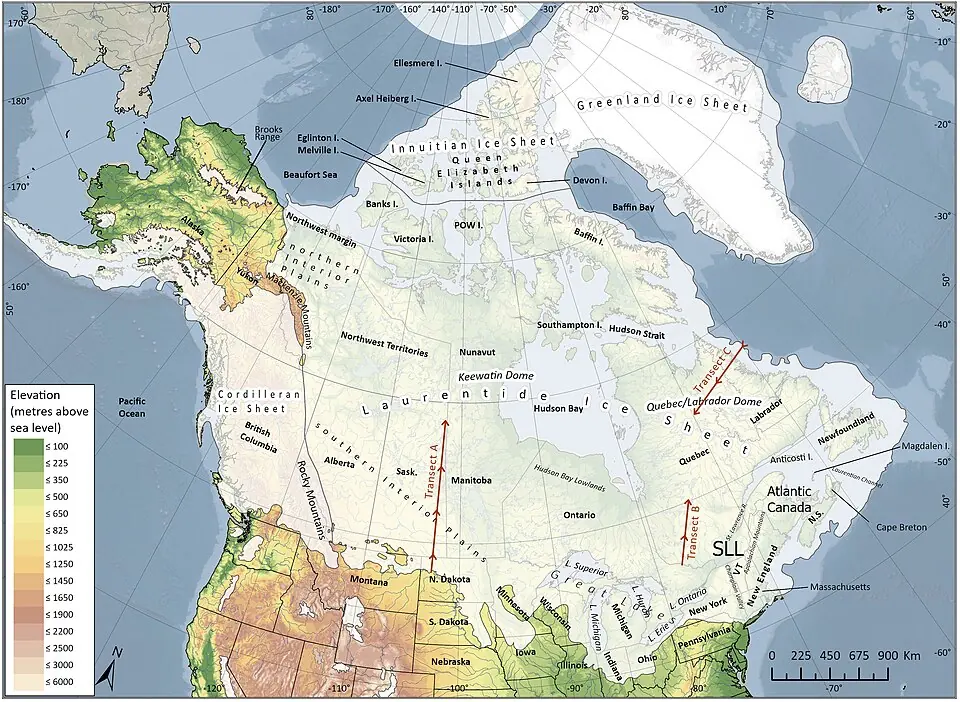
The Last Glacial Maximum designates the period, between about 26,500 and 19,000 years ago, during which the northern hemisphere ice sheets reached their greatest extent, covering Canada and Scandinavia to a thickness of several kilometres, while sea level stood 120 to 140 metres below the present. The two phenomena are one: the snow constituting the ice sheets comes from oceanic evaporation, and for as long as it remains solid on the continents it does not return to the sea. The retreat of the shorelines connected Asia to America and Australia to New Guinea. Human populations concentrated in refuges, and the habitable surface was simultaneously enlarged, on the exposed continental shelves, and made more constraining elsewhere.
Why it matters
The period constitutes the frame within which the peopling of the world is completed: the lowering of sea level opens the passages by which the Americas are reached, the cold isolates populations whose separation remains legible in present-day genomes, and the later rise of the waters submerges about a fifth of the land then exposed, a process observable within a few generations.
Dating & uncertainty
The period is defined from thousands of dated glacial deposits: almost all ice sheets stand at their maximum between about 26,500 and 19,000 years ago, deglaciation beginning in the northern hemisphere around 19,000 to 20,000 years. The value of 21,000 years corresponds to the conventional centre of the period and not to a particular event.
Our species’ history as one day
22:24:001 h 36 min before midnight
if the 315,000 years of Homo sapiens were compressed into a single day