GENETICS
Denny: a Neanderthal-Denisovan Hybrid
between ~140,000 and ~80,000 years ago
Palaeolithic · Middle Stone Age · Last glacial
A bone fragment from Siberia belonged to a girl with a Neanderthal mother and a Denisovan father: the two lineages interbred directly.
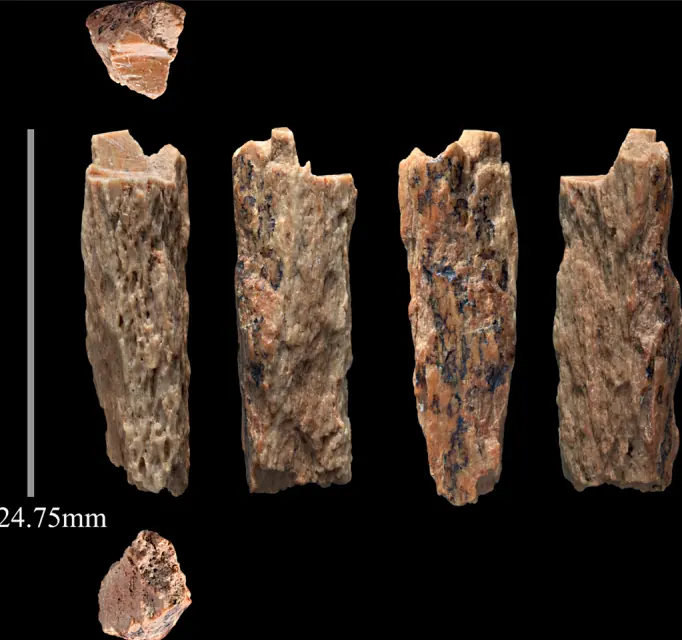
Denisova 11, nicknamed Denny, is a long-bone fragment recovered from Denisova Cave in the Altai Mountains of Siberia and published in 2018. Analysis of its DNA established that it came from an adolescent girl born to a Neanderthal mother and a Denisovan father, that is, from a first-generation union. The criterion permitting that conclusion is the length of the ancestry segments: in a first-generation individual, half the genome comes from each population and the two ancestries alternate in long continuous blocks, whereas admixture several generations back appears as short segments, recombination having fragmented them at each transmission. The paternal lineage also carried traces of older Neanderthal ancestry, and the mother belonged with later Neanderthals of western Europe rather than with an older Neanderthal from the same site.
Why it matters
The identification of a first-generation individual among the small number of archaic humans whose genome has been sequenced leads several authors to consider that such unions were not exceptional. The model of human species coexisting without genetic exchange is abandoned in favour of recurrent admixture in contact zones, of which present-day genomes retain the trace.
Dating & uncertainty
Direct radiocarbon dating establishes only an age greater than 50,000 years, the limit beyond which the method no longer has enough measurable carbon. A Bayesian model combining radiocarbon, uranium-series, optical ages, stratigraphy and genetic data places Denisova 11 between about 140,000 and 80,000 years.
Our species’ history as one day
15:37:088 h 23 min before midnight
if the 315,000 years of Homo sapiens were compressed into a single day