ART × BELIEFS
Chauvet Cave: Aurignacian Art
~37,000–33,500 years ago
Palaeolithic · Upper Palaeolithic · Last glacial
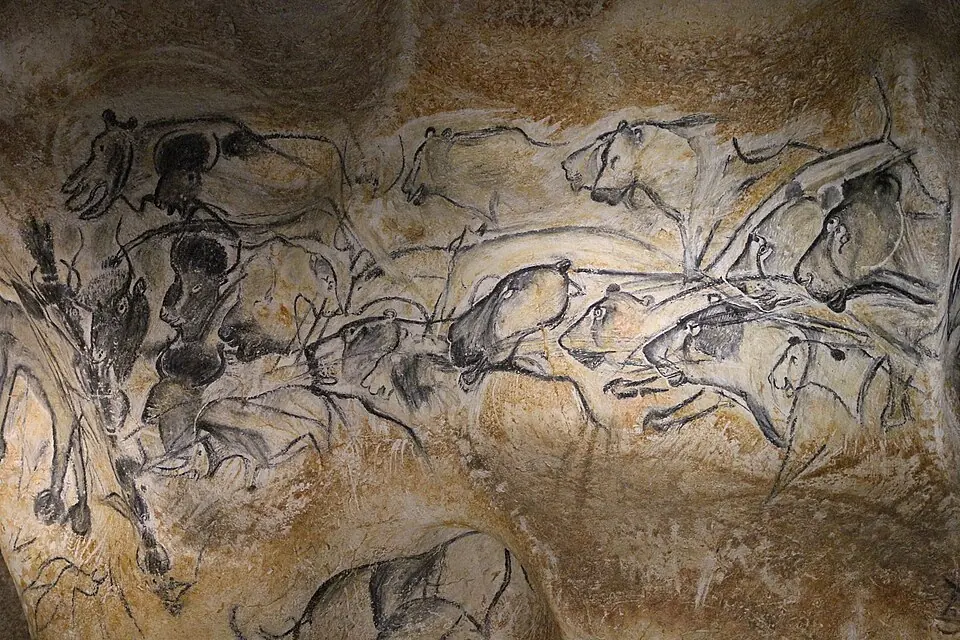
The walls of Chauvet Cave, in the Ardeche, carry lions, rhinoceroses and horses drawn in charcoal about 36,000 years ago, dated directly by the pigment.
The Chauvet-Pont-d'Arc cave, discovered in 1994 in the Ardeche and inscribed as a World Heritage site in 2014, is a decorated cavity overlooking the Ardeche gorges, whose walls carry representations of lions, rhinoceroses and horses executed in charcoal and ochre. The presence of charcoal determines the chronology of the site: the line itself contains carbon of plant origin and is amenable to radiocarbon, which a mineral pigment such as ochre is not. More than 350 physical dates, combined in a single chronological model, place the first period of use between 37,000 and 33,500 years ago. Cliff collapses subsequently blocked the entrance. The ensemble is not the oldest known, a narrative scene in Sulawesi predating 51,200 years, but no older ensemble attains this scale.
Why it matters
The site contradicts the model of a gradual evolution of graphic competence, paintings among the oldest in Europe being among the most elaborate recorded there, and being the work of hunter-gatherers of the glacial steppe. Set beside the earlier Indonesian caves, it documents the practice of representation and of narrative composition at both ends of the inhabited world, several tens of millennia before writing.
Dating & uncertaintyDisputed
The chronological model places a first period of use between 37,000 and 33,500 years ago and a second between 31,000 and 28,000. Successive cliff collapses closed access at least 21,000 years ago, which excludes any later intervention. A minority of specialists contest the radiocarbon dates and argue, from style, faunal remains and stratigraphy, for a later chronology. What is at stake is explicit: the late reading would preserve the model of a gradual maturation of painting, which the physical dating contradicts.
Our species’ history as one day
21:13:082 h 47 min before midnight
if the 315,000 years of Homo sapiens were compressed into a single day