PEOPLING × BELIEFS
Homo naledi: a Small-Brained Human
~250,000 years ago
Palaeolithic · Middle Stone Age · MIS 8
A small-brained human species, Homo naledi, was still living in South Africa about 250,000 years ago, deep in the Rising Star caves.
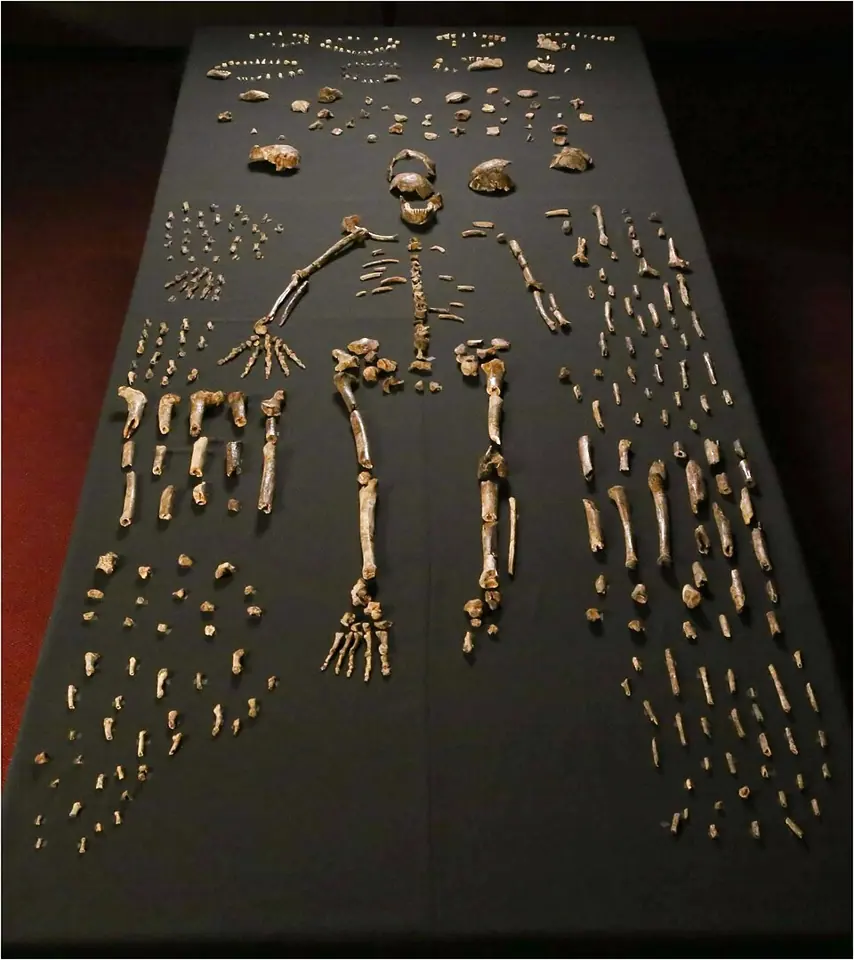
Homo naledi is a hominin species described in 2015 from remains discovered in 2013 in the Rising Star cave system, north-west of Johannesburg, South Africa. Small-bodied, with a brain roughly a third the volume of that of Homo sapiens, it is represented by several dozen individuals deposited in dark chambers of difficult access. One chamber alone has yielded at least fifteen individuals, almost to the exclusion of other animals. That composition is the principal argument: a flood or a carnivore den mixes the bones of many species, so a chamber containing only humans lends itself poorly to an accidental explanation. The excavation team holds that the bodies were carried in and buried deliberately, an interpretation against which other researchers object that natural processes have not been conclusively excluded.
Why it matters
The discovery constitutes, after that of Homo floresiensis, the second recent revision of the composition of the human family: Homo sapiens shared its continent of origin with a relative of markedly smaller brain. What turns on the burial hypothesis is explicit: if it is confirmed, treatment of the dead does not require a large brain, and part of what the literature classes as symbolic behaviour must be re-examined. Whatever the verdict, the case is one of those argued out publicly, piece by piece.
Dating & uncertaintyDisputed
Dating places the fossil-bearing sediments between about 414,000 and 236,000 years; direct measurements on teeth, combined with that of the flowstone above them, narrow the age of the fossils to between about 335,000 and 236,000 years. The controversy concerns not these dates but the behavioural interpretation. The hypothesis of deliberate burial, outlined in 2015 and formalised in 2023, is contested on the grounds that natural accumulation was set aside too quickly.
Our species’ history as one day
04:57:0819 h 3 min before midnight
if the 315,000 years of Homo sapiens were compressed into a single day