ENVIRONMENT
The Toba Eruption
~74,000 years ago
Palaeolithic · Middle Stone Age · Last glacial
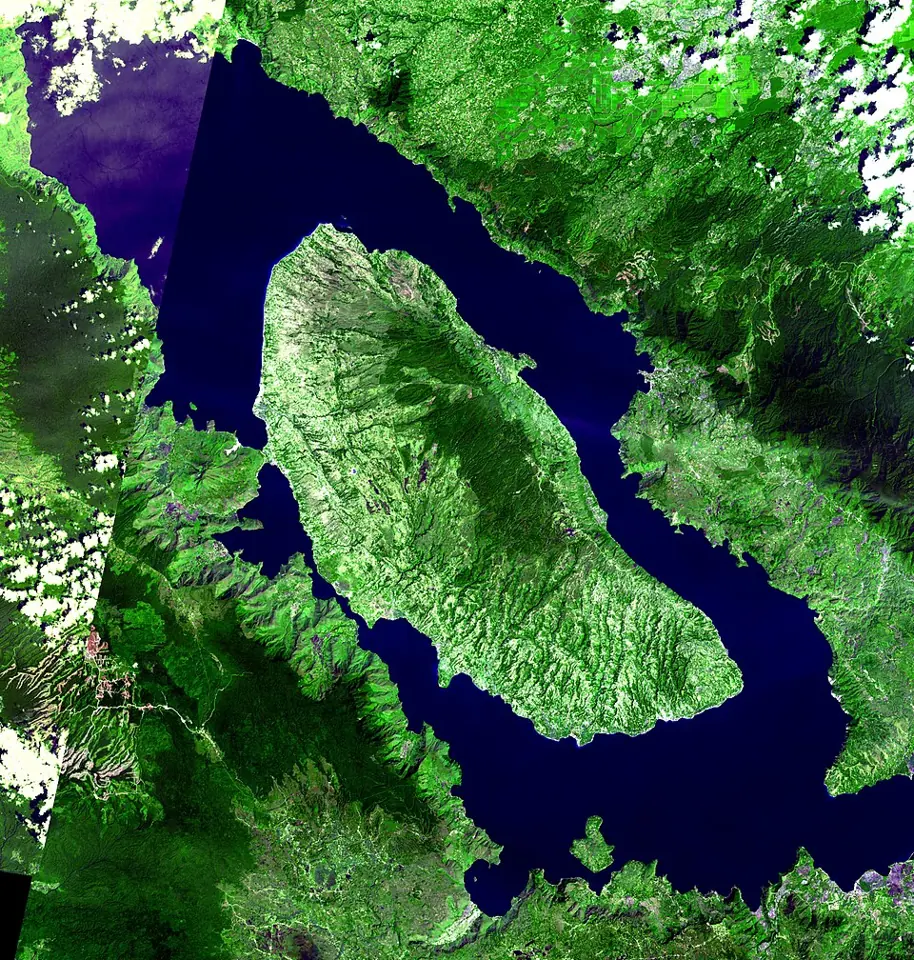
About 74,000 years ago the Toba volcano, in Sumatra, produced the largest eruption of the last two and a half million years.
The Toba eruption is a volcanic eruption that occurred about 74,000 years ago in the Toba caldera, in northern Sumatra, Indonesia. Classed at the highest rank of the volcanic explosivity index, it constitutes the largest known eruption of the last two and a half million years and dispersed its ash across a large part of the eastern hemisphere. It was long held responsible for a global volcanic winter that reduced humanity to the brink of extinction. Current data do not support that reconstruction: the sediments of an East African lake containing the ash record no cooling of that magnitude, and at two South African sites the same volcanic glass is included in levels of continuous human occupation.
Why it matters
The case illustrates the revision of a causal hypothesis through improved archives: the Toba catastrophe supplied a single explanation for the low genetic diversity of the species, and genetic studies no longer support the existence of a bottleneck at that date. The eruption retains, by contrast, its value as a chronological marker, for a reason inherent to its nature: an eruption lays down its ash within weeks and its glass carries a distinctive chemical composition, so that a single identifiable layer ties sites separated by an ocean to the same moment.
Dating & uncertainty
The date of the eruption, around 74,000 years ago, is well established, and its microscopic glass is identified from Sumatra to South Africa. It is the magnitude of its effects that is debated: high-resolution climate archives and the continuity of archaeological sequences have set aside the hypothesis of a global volcanic winter. A signal nevertheless remains, the Lake Malawi sediments showing, immediately above the ash, an increase in charcoal and drought-adapted grasses, indicating reduced precipitation and the loss of part of the upland vegetation.
Our species’ history as one day
18:21:425 h 38 min before midnight
if the 315,000 years of Homo sapiens were compressed into a single day