PEOPLING
Bluefish Caves: Ice Age Hunters in Yukon?
~24,000 years ago (debated)
Palaeolithic · Upper Palaeolithic · Last glacial · Last Glacial Maximum
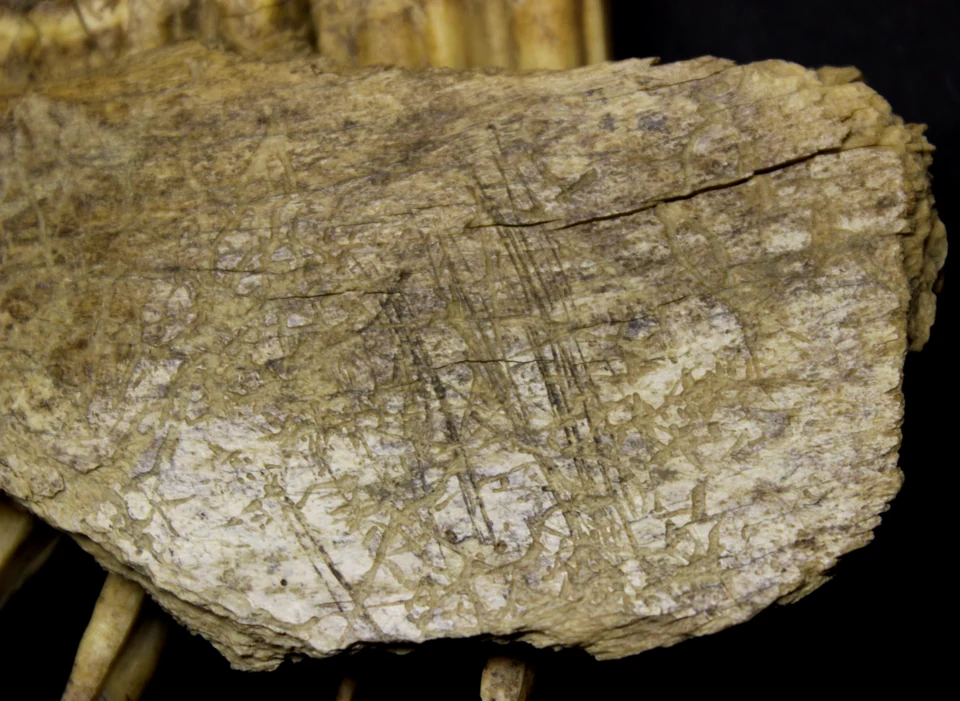
In the Bluefish Caves, in Canada's Yukon, a horse jaw about 24,000 years old bears grooves that some archaeologists attribute to a stone tool and others to natural causes.
The Bluefish Caves are three small caves at the foot of a limestone ridge in northern Yukon, in Canada. Jacques Cinq-Mars, of the Archaeological Survey of Canada, led excavations there from 1977 to 1987. The excavators found animal bones and about a hundred stone tools in a layer of loess, a fine silt laid down by the wind. In 2017, Bourgeon and colleagues examined 36,000 of these bones and found cut marks on 15 of them. Cut marks are grooves left by a stone blade during skinning, dismembering or the removal of meat. They appear on bones of horse, caribou and wapiti. The oldest marked bone, a horse jaw, is about 24,000 years old. That age falls within the Last Glacial Maximum, between about 26,500 and 19,000 years ago, when the ice sheets were at their largest. If people made the marks, they were then living in eastern Beringia. Beringia covers eastern Siberia, Alaska and Yukon, which formed a single landmass when the sea stood lower.
Why it matters
According to the genetic studies summarised by Bourgeon and Burke in 2021, the ancestors of Native Americans separated from other Asian populations about 25,000 years ago. They then remained isolated during the Last Glacial Maximum. Under the Beringian standstill hypothesis, this isolated population lived in Beringia and spread through the rest of the Americas once the ice sheets retreated. Few archaeological remains of that period have been found in eastern Siberia and Beringia. Bourgeon and colleagues present the Bluefish bones as such remains, from the eastern edge of the area that population occupied.
Dating & uncertaintyDisputed
Radiocarbon dating measures the carbon 14 left in a bone. The horse jaw was dated to 19,650 radiocarbon years, give or take 130. Such ages must be converted into calendar years, because the carbon 14 content of the air has varied. Converted, this age is about 24,000 years. In 2020, Krasinski and Blong judged the evidence unconvincing. They doubt that the stone tools are as old as the dated bones. They argue that the loess layer was disturbed and its contents mixed. They also suggest that natural processes, rather than people, altered the bones. In 2021, Bourgeon and Burke placed the earliest hunting at the site at about 23,500 years ago. In 2023, Litynski and Pante tested one natural cause, falling rock, by dropping limestone blocks onto animal bones. Under the microscope, the damage differed from cut marks. They concluded that falling rock did not produce the Bluefish marks.
Our species’ history as one day
22:10:171 h 50 min before midnight
if the 315,000 years of Homo sapiens were compressed into a single day