Peopling of the Earth· Above the timeline
Homo sapiens migrations out of Africa
350 ka → Today
Above the Sapiens timeline, an animated globe represents the spread of Homo sapiens out of Africa, date by date.
01What can be seen on the planet
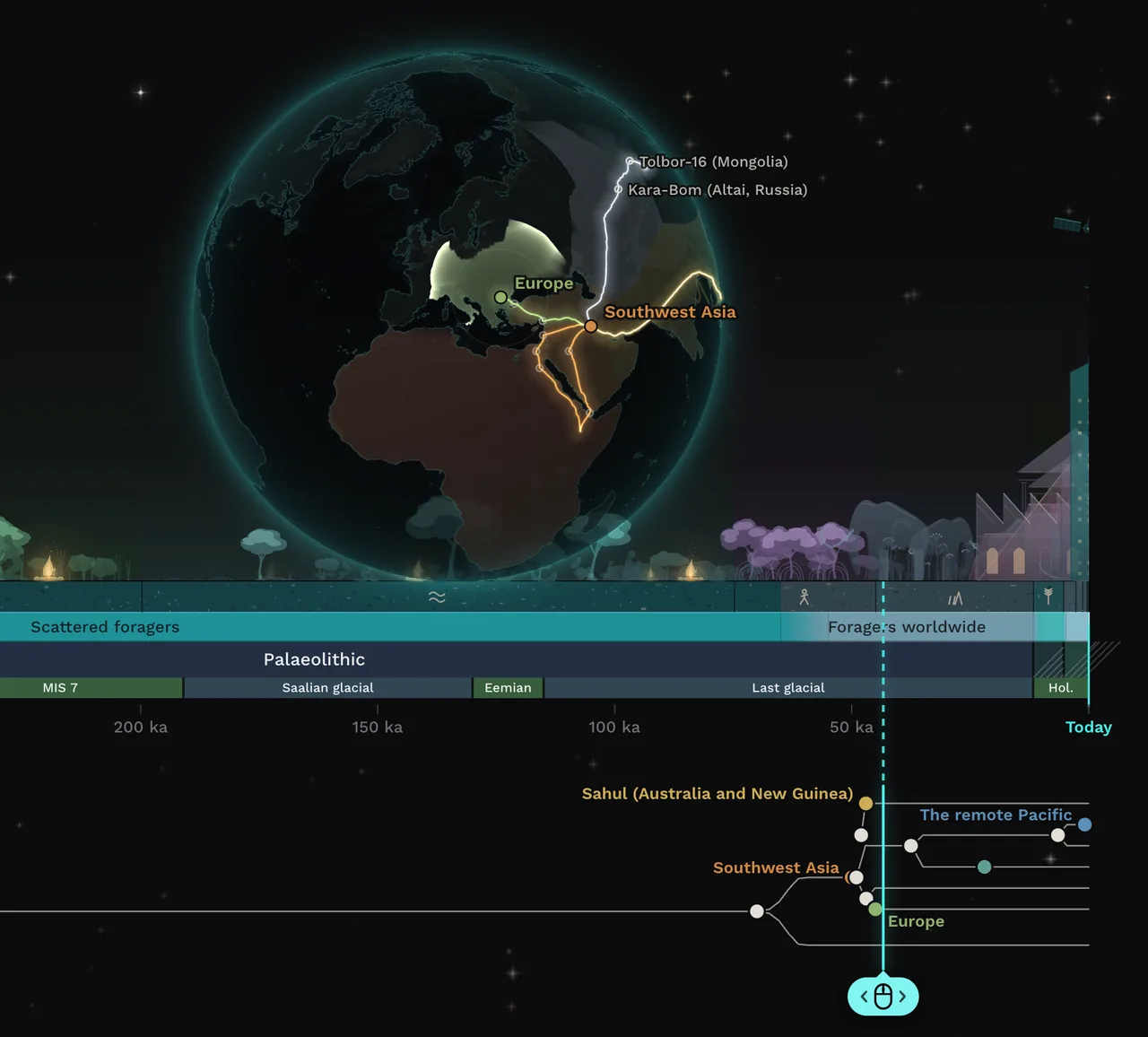
The animated globe offers a three-dimensional graphic representation of the world at the date marked by the vertical line on the timeline. The reader can move this line to any date over the last 350,000 years. While the reader drags it, the planet grows larger on screen. When the reader lets go, the planet returns to its usual size. The planet turns by itself so that the migrations in progress at the period explored can be followed. The reader can also turn it by hand.
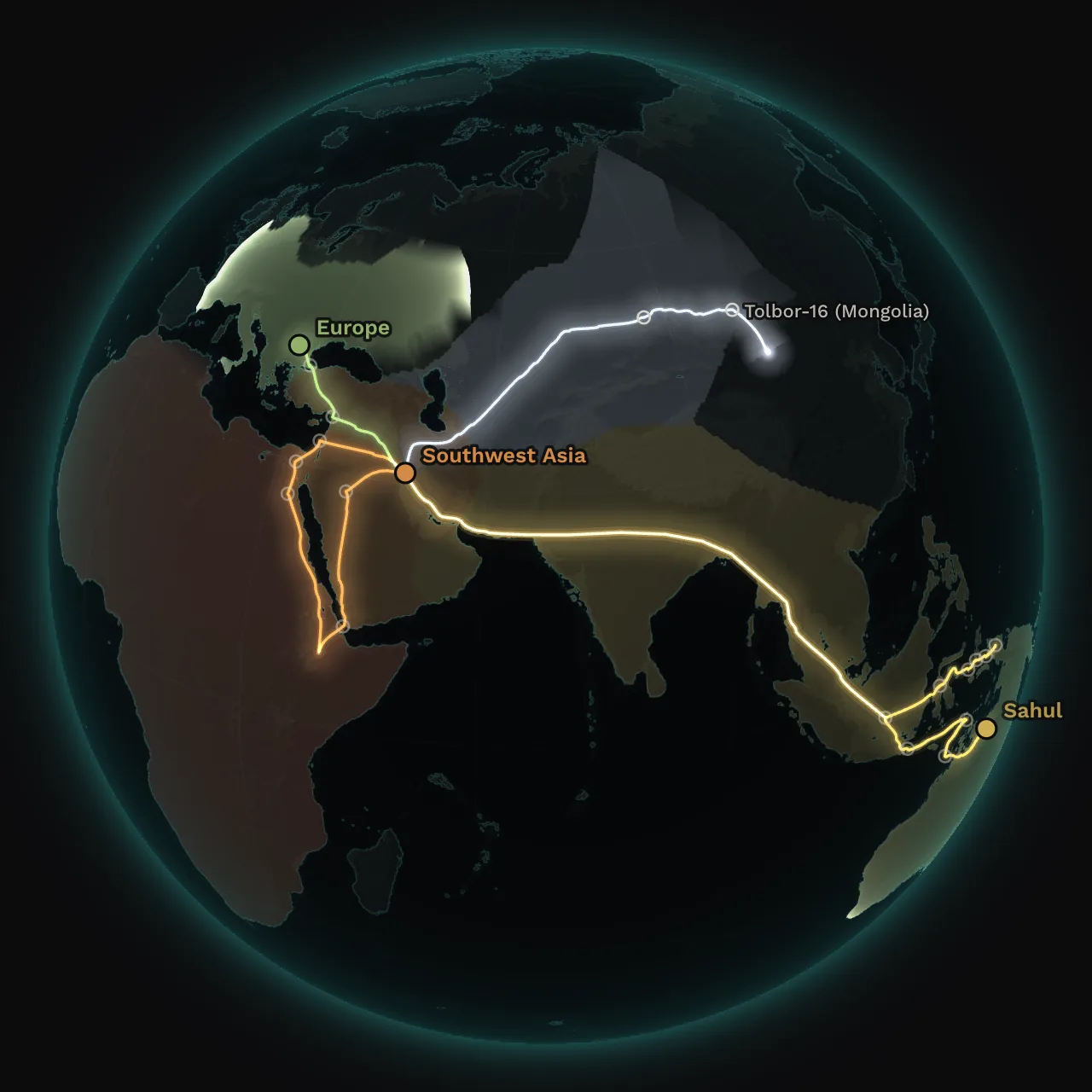
Coastlines and ice. The coastlines shown are those of the chosen date, not today's. They follow the sea level of that time, as reconstructed by Spratt and Lisiecki 1. When the sea was lower, land now under water was exposed. The floor of today's Bering Strait thus connected Siberia to Alaska. Beringia refers to this exposed land and the neighbouring regions, from eastern Siberia to north-western Canada. The ice sheets are painted in blue-grey. Peltier and colleagues 2 reconstructed them for the last 26,000 years only. For earlier dates, the planet shows no ice sheet, even where there was one.
Routes. A lineage is a set of human groups descended from one ancestral group. Each route represents the movement of a lineage. It lengthens as the reader drags the line towards the present. A lineage can follow several routes. Each lineage has the colour of its region of arrival. The routes are orange for Southwest Asia, gold for Sahul, green for Europe, blue-green for the Americas and blue for the remote Pacific, that is, East Polynesia. The grey route is that of the eastern lineage, the ancestors of East Asian populations. The lineages of the Americas and of the remote Pacific descend from it.
Destinations. The migrations ribbon, below the timeline, gives the date of arrival of each lineage in different regions of the globe. On the planet, a dot in the lineage's colour marks this arrival. The grey route of the eastern lineage ends at a light grey dot, which marks Tianyuan Cave, in China. Clicking a dot opens the corresponding entry, as on the timeline's ribbon.
Coloured land. Mainland Africa has its own colour, a brick red. It is entirely coloured 315,000 years ago. Outside Africa, land takes the colour of the first route that passes near it.
Sahul, Europe and the Americas. In each of these regions, the colour stands for people settling the region after their arrival.
02How the routes are drawn
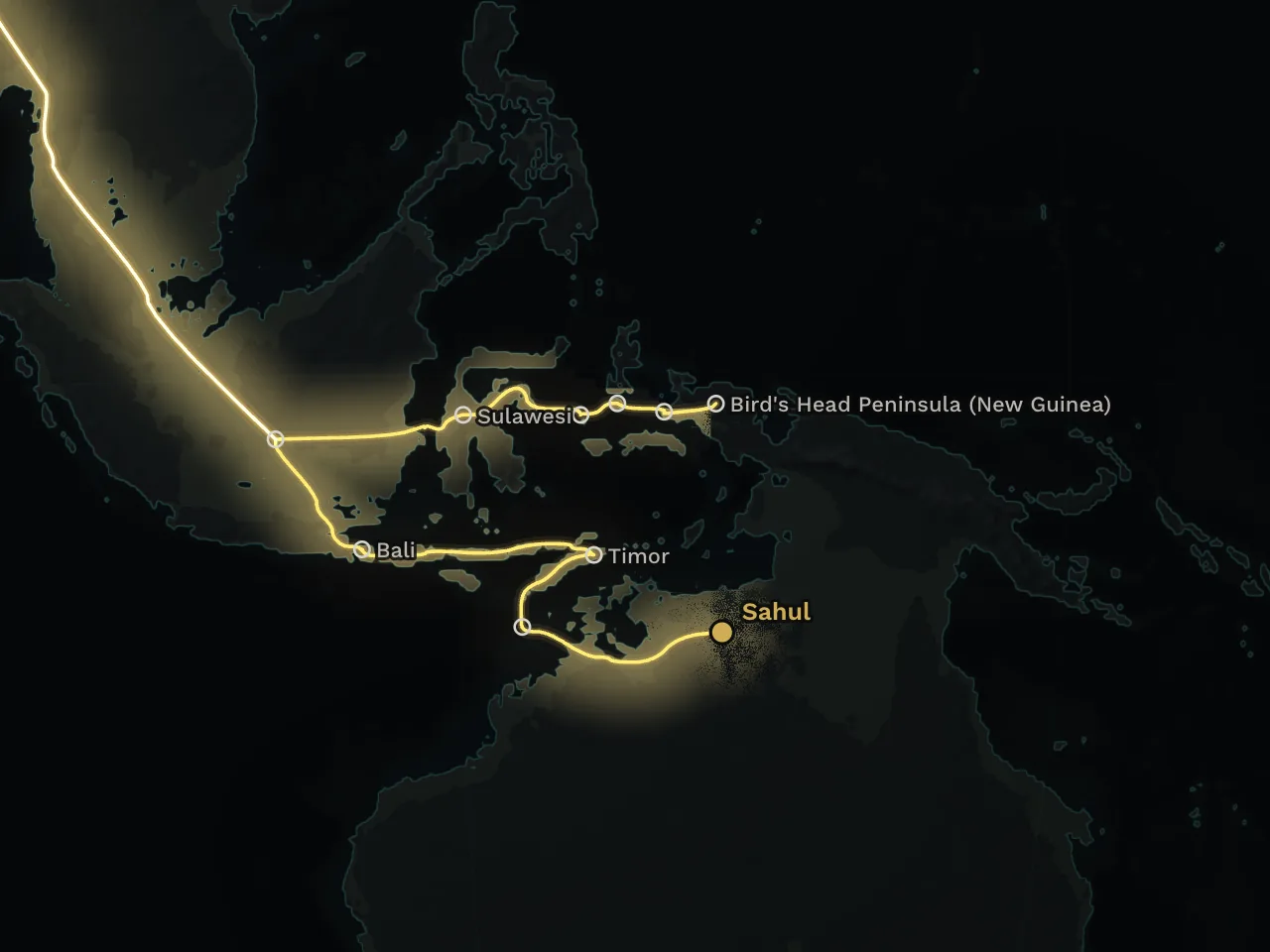
Between two waypoints, each route follows the easiest path to travel, known as the least-cost path. It avoids high mountains, ice and sea as far as possible. Kealy and colleagues 3 calculated such paths to reconstruct the crossing from Southeast Asia to Sahul. The calculation uses the coastlines and ice of the date at which the route passes 1, 2.
03Waypoints and their dates
Some waypoints are dated sites where human remains have been found, such as Bacho Kiro Cave in Bulgaria 5. The route passes them at the published date.
Other waypoints are sites where only stone tools have been found, with no human remains. This is the case at Kara-Bom, in the Altai Mountains of Siberia. Researchers attribute these tools to Homo sapiens from the way the stone was worked. Rybin and colleagues 6 assign the tools of Kara-Bom to the Initial Upper Palaeolithic. This name refers to a way of working stone into blades, long sharp flakes. In their account, it appears about 50,000 years ago in the Levant, on the eastern Mediterranean coast. They link its spread eastwards to that of Homo sapiens.
04When land is coloured
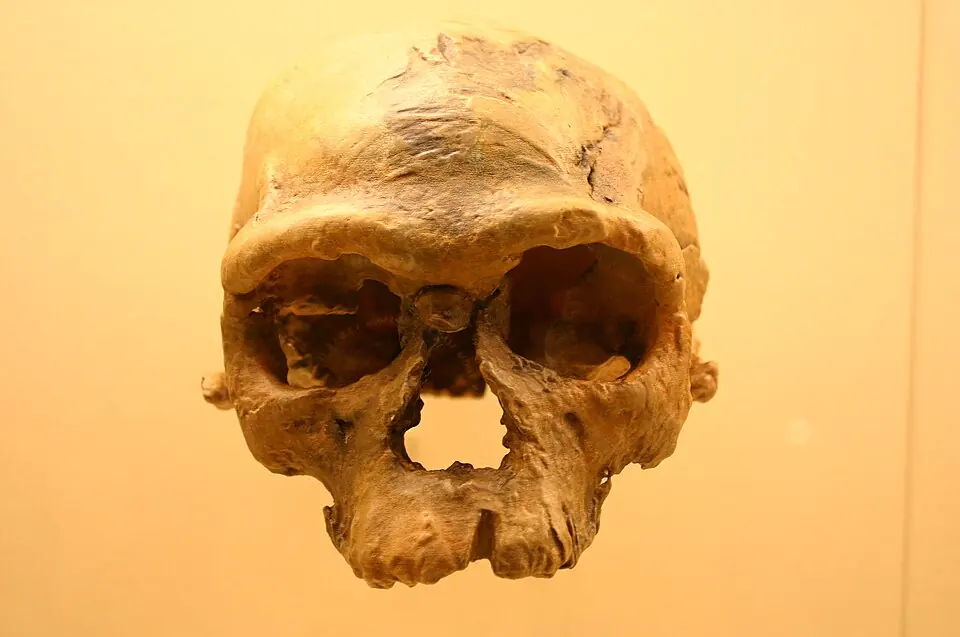
On the planet, mainland Africa is coloured at once at the age of the fossils of Jebel Irhoud, a site in Morocco. Before 2017, the oldest known Homo sapiens fossils came from East Africa. That year, Richter and colleagues 8 dated the Jebel Irhoud fossils to about 315,000 years ago. According to them, these were then the oldest known fossils of the species. Jebel Irhoud lies far from East Africa. For these authors, the species may therefore have emerged in several regions of Africa rather than in one.
Along a migration route, its colour gradually spreads to the neighbouring land. In Sahul, Europe and the Americas, the colour starts from the lineage's arrival point; there it advances more slowly in the mountains.
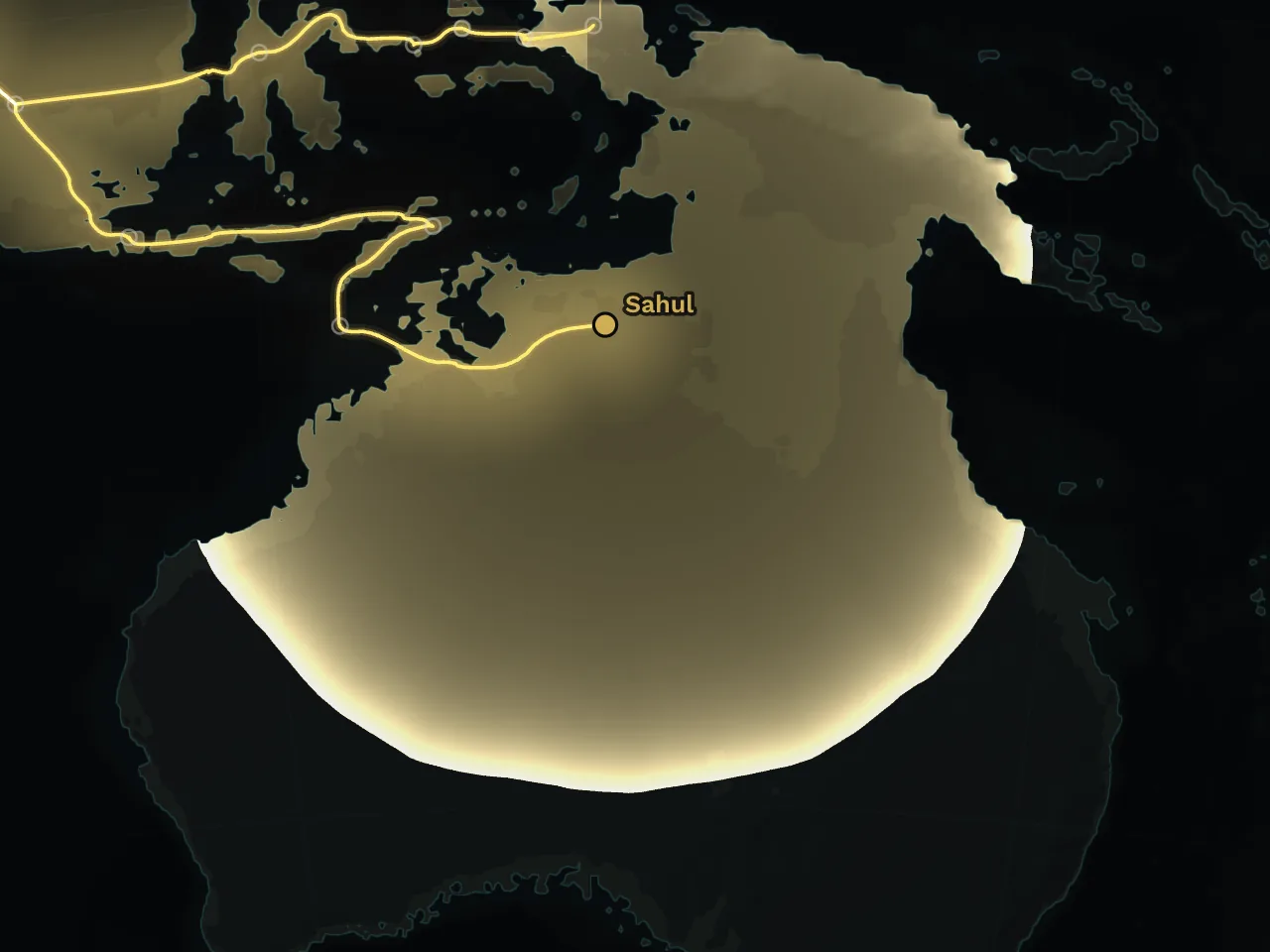
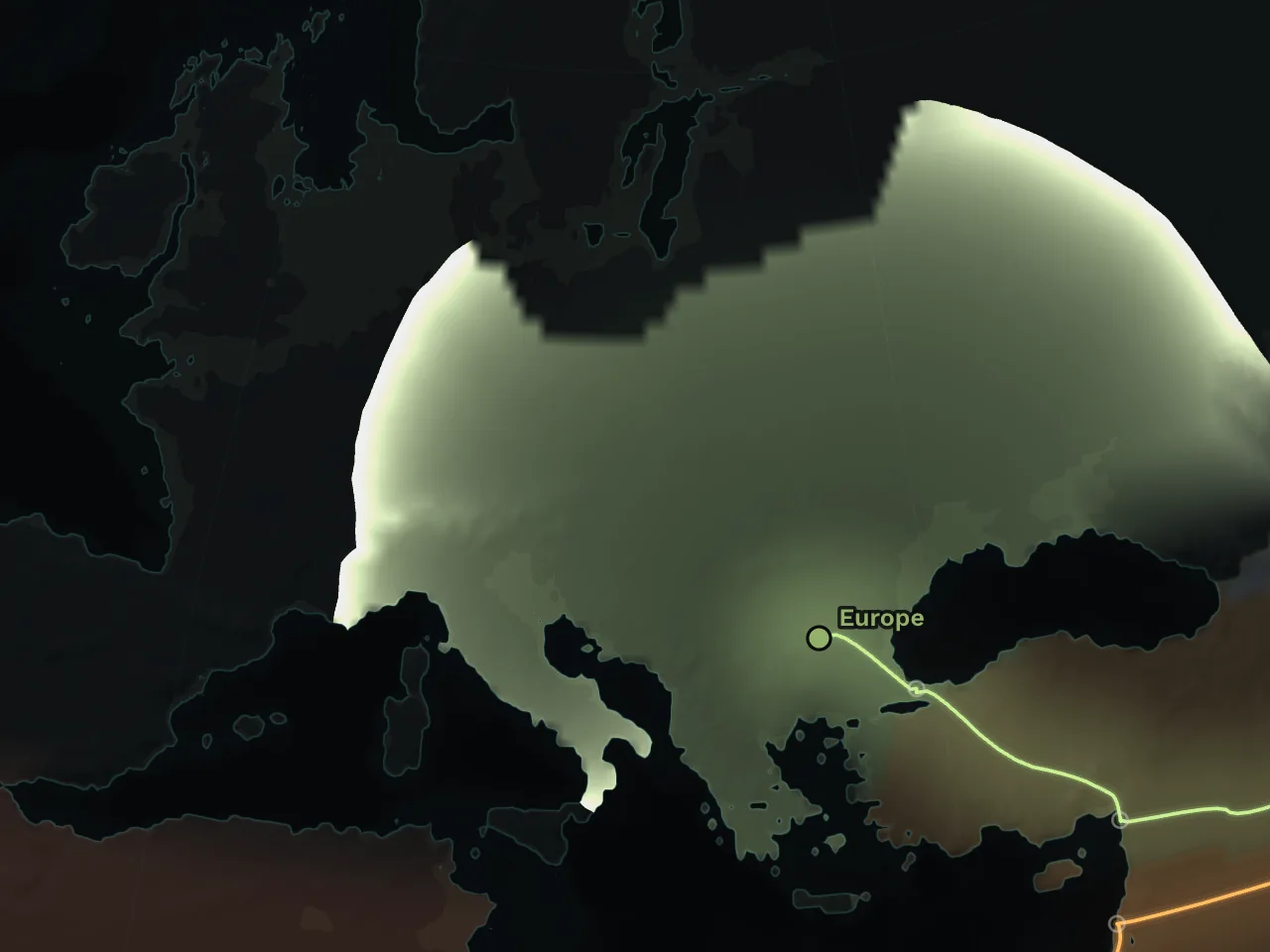
In Europe and the Americas, the speed at which the colour spreads is set so that it reaches a site at the published date. For Europe, this site is Kent's Cavern, a cave in England 9. For the Americas, it is Monte Verde, an archaeological site in Chile 10. In Sahul, the colour covers the continent in about 5,000 years. This is the duration of the peopling in a computer simulation by Bradshaw and colleagues 11.
Everywhere else, the colour advances a little over a kilometre a year, whatever the terrain. It crosses stretches of sea up to about a hundred kilometres wide. More distant islands, such as Madagascar, Iceland and New Caledonia, stay without colour. They are coloured only at the present day, with all the land inhabited today. The colour of a land therefore does not give the date of its settlement.
05Region by region
Southwest Asia. On the planet, the routes leave East Africa 70,000 years ago. According to Vallini and colleagues 12, the exit from Africa took place between 70,000 and 60,000 years ago. For these authors, the ancestors of the present-day populations of Eurasia, Oceania and the Americas then lived on the Persian Plateau, in present-day Iran. They stayed there until about 45,000 years ago. Tobler and colleagues 13 place this stay in the Arabian Peninsula instead, for about 30,000 years. On the planet, the two orange routes meet 50,000 years ago, the date given by the ribbon. Their meeting point lies at the foot of the Zagros Mountains, between these two regions. The route to Sahul leaves it 49,000 years ago, when the ribbon separates the eastern and western lineages.
Sahul. Both branches of the route reach Sahul about 47,000 years ago. This is the age that O'Connell and Allen 14 give for its first occupation. This age is debated. Clarkson and colleagues 15 date human occupation to about 65,000 years ago at Madjedbebe, a rock shelter in northern Australia. For O'Connell and colleagues 16, an age of more than 50,000 years is unlikely for the site. By contrast, the genetic study by Gandini and colleagues 4 supports an arrival 65,000 to 60,000 years ago.
Sümer and colleagues 17 analysed the oldest known Homo sapiens genomes. They find that every non-African population studied carries Neanderthal DNA inherited from a single episode of interbreeding. This episode dates from between 49,000 and 45,000 years ago. The Indigenous peoples of Australia and New Guinea also carry its trace. If this episode was indeed unique, their ancestors reached Sahul less than 49,000 years ago.
Europe. According to Slimak and colleagues 18, Homo sapiens were present at Mandrin Cave, in France, between 56,800 and 51,700 years ago. These authors see this as an incursion into Neanderthal territory. The planet does not show it, because it gives only one arrival per region. In Europe, this arrival is at Bacho Kiro Cave, in Bulgaria, about 45,000 years ago 5.
Hajdinjak and colleagues 19 analysed the DNA of the people of Bacho Kiro. They find them genetically closer to the populations of East Asia and the Americas than to later inhabitants of western Eurasia. Fu and colleagues 20 found no evidence that the earliest Homo sapiens of Europe contributed to the genetic make-up of present-day Europeans. The colour of Europe nevertheless starts from Bacho Kiro, the ribbon's dated site of arrival.
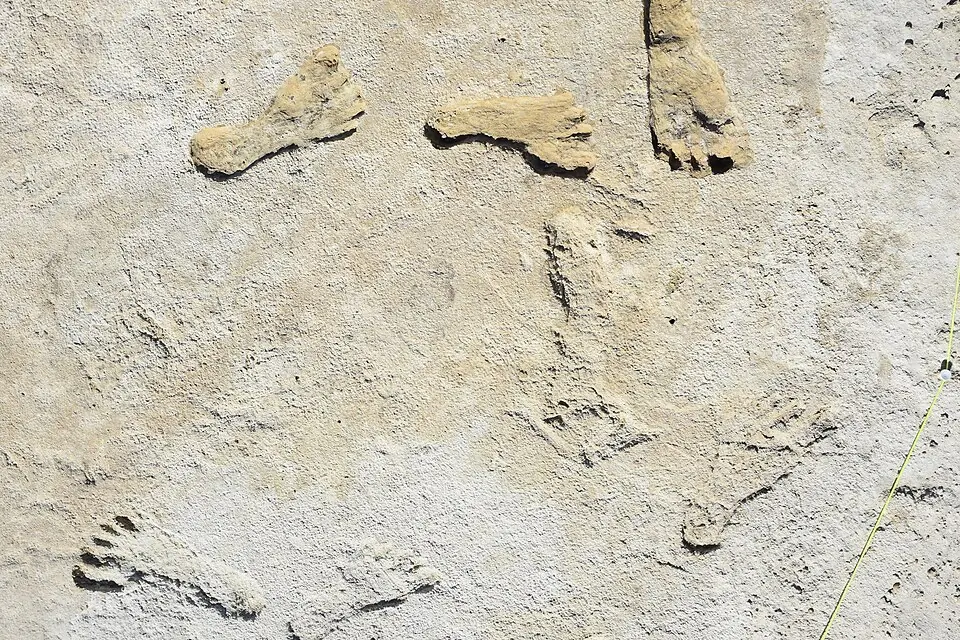
The Americas. The route to the Americas leaves Tianyuan Cave, in China. It halts in Beringia 25,000 years ago. According to Moreno-Mayar and colleagues 21, the ancestors of Native Americans then stop interbreeding with the populations of East Asia. The route sets off again 24,500 years ago. According to Praetorius and colleagues 22, a period favourable to travel along the Pacific coast begins at that date. In their account, marine food there was varied all year round. They add that people could travel along the coast by boat or on foot over the sea ice. The route follows this coast before turning inland. It reaches White Sands about 22,000 years ago, within the age range of the footprints at the site 7.
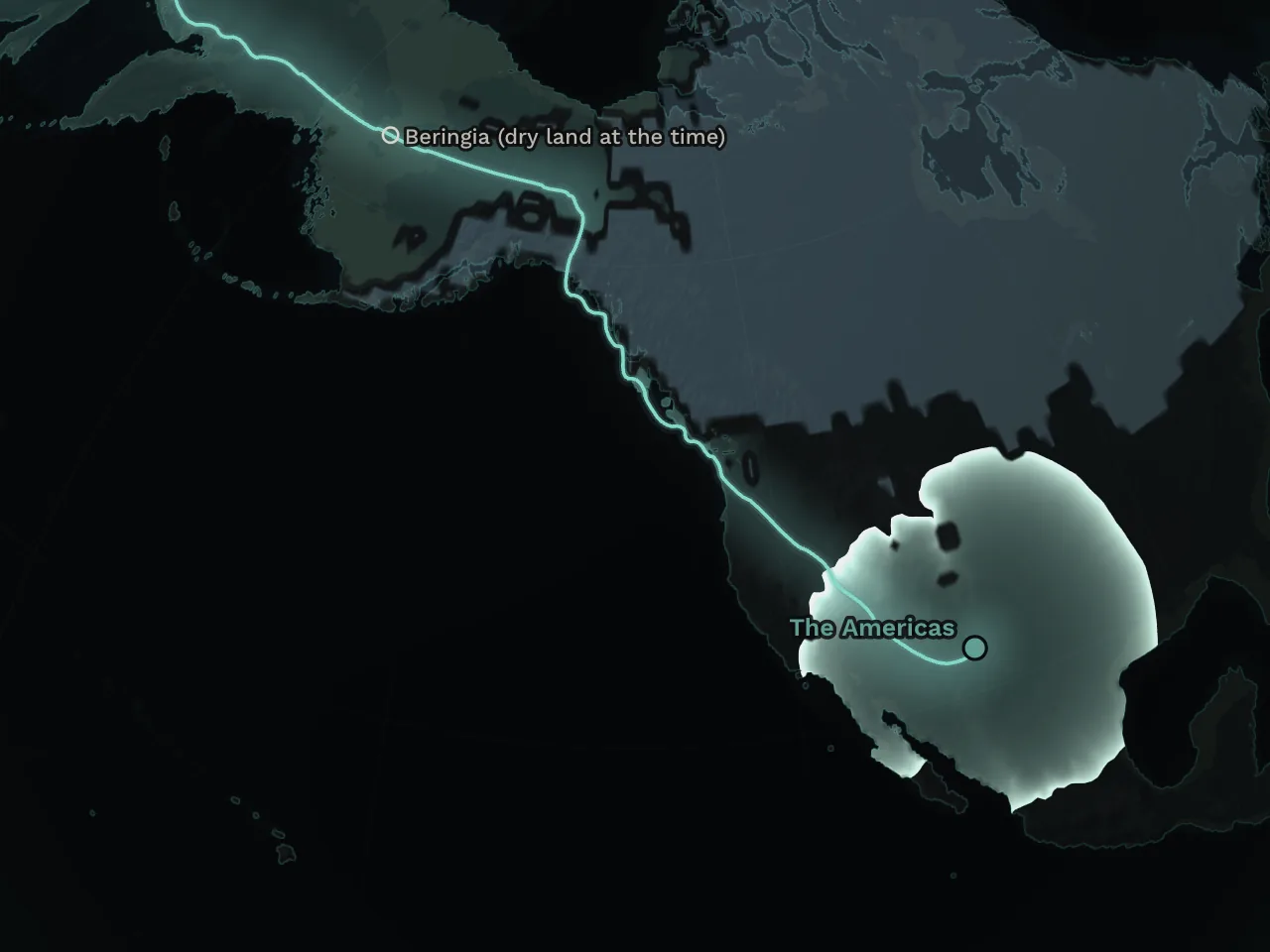
Llamas and colleagues 23 place the arrival of the ancestors of Native Americans south of the ice sheets about 16,000 years ago. Pinotti and colleagues 24 place it less than 19,500 years ago. Both studies rely on DNA. The White Sands footprints are therefore older than both datings. According to Willerslev and Meltzer 25, the first people to reach the Americas included groups with no known descendants. If the footprints come from such groups, their age and these datings are compatible.
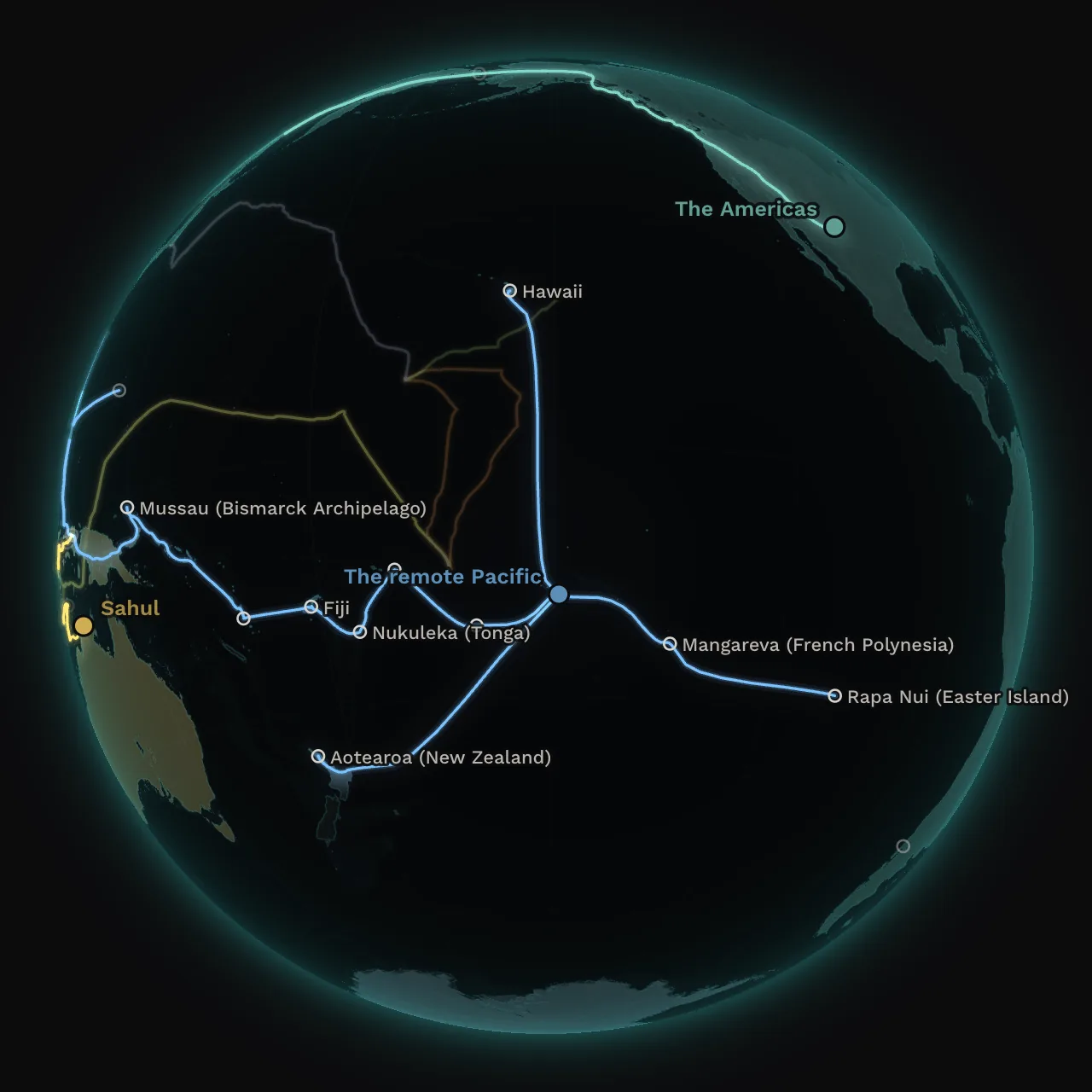
The remote Pacific. For this region, dates are given in calendar years, as on the ribbon. East Polynesia includes Hawaii, Easter Island and New Zealand. Its archipelagos were the last habitable lands settled by humans 26. On the planet, Easter Island and New Zealand bear their Polynesian names, Rapa Nui and Aotearoa. The route to the remote Pacific starts on the coast of Fujian, in China. It passes through Taiwan, then Luzon, in the Philippines. From Luzon, a branch reaches the Mariana Islands, settled about 1500 BCE 27. The main route then passes through Vanuatu and Fiji. It reaches Tonga, settled about 900 BCE 28, then Samoa.
Ioannidis and colleagues 29 reconstructed the order of settlement from the genomes of 430 present-day islanders. In their reconstruction, Polynesians went from Samoa to the Cook Islands, then to the Society Islands in the 11th century. Wilmshurst and colleagues 26 compiled the radiocarbon dates of the region. According to these dates, the Society Islands were instead settled before the Cook Islands. The planet shows the order proposed by Ioannidis and colleagues. The route halts in the Society Islands until about 1200 CE. This is the date of arrival that the ribbon gives for the region. The branches to Rapa Nui, Hawaii and Aotearoa leave from the Society Islands.