LIFE
Alkaline Hydrothermal Vents
~4.2 billion years ago (setting debated)
Alkaline hydrothermal vents are springs on the deep sea floor where seawater that has reacted with the rock comes back out warm, alkaline and rich in hydrogen, and they are one proposed setting for the origin of life.
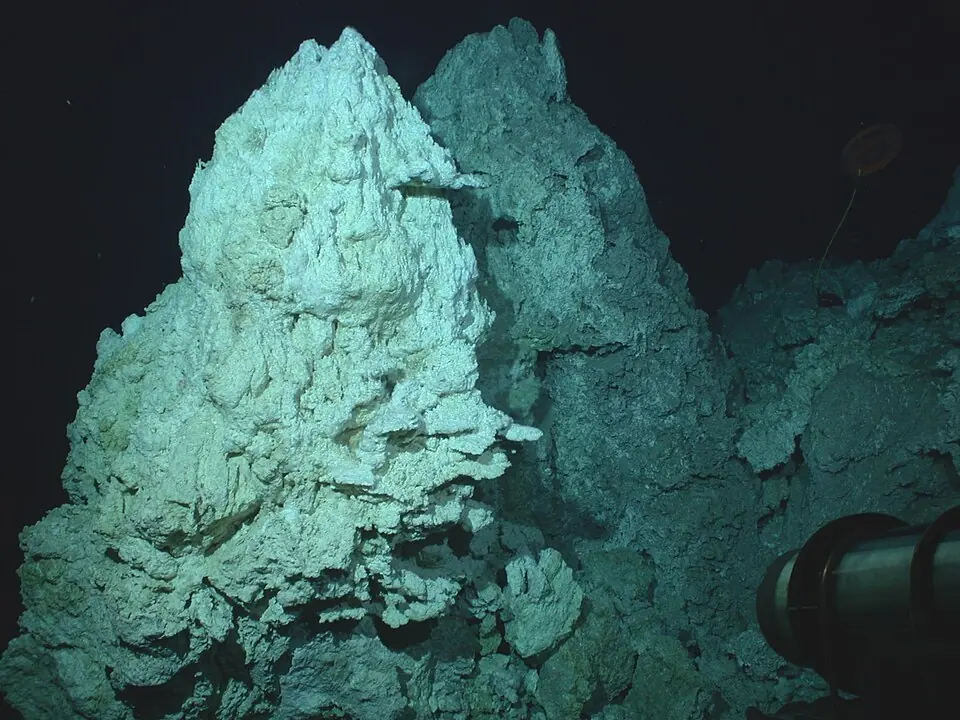
An alkaline hydrothermal vent is a spring on the deep sea floor whose warm water is alkaline, the opposite of acidic. Such vents are one proposed setting for the origin of life. Seawater seeps into rock rich in iron and magnesium and converts it to serpentine, a soft green mineral. This reaction, called serpentinisation, releases hydrogen. The warm alkaline fluid then wells back into the ocean of the early Earth, which was mildly acidic, and builds chimneys full of microscopic pores. The thin mineral wall of each pore separates fluids of different acidity. Acidity is the concentration of protons, electrically charged particles. This difference is therefore an electrochemical gradient, a difference of both concentration and charge across a wall. It has the same polarity, or direction, and much the same strength as the gradient that every living cell still uses to power itself.
Why it matters
Every living cell maintains a usable difference of charge between its inside and its outside, and must do so by its own means. In an alkaline vent, the mineral walls themselves maintain such a difference, without biological intervention. Of all the settings proposed for the appearance of life, the alkaline vent is the one in which the rock does this.
Dating & uncertaintyDisputed
The date of about 4.2 billion years ago is not measured on the vents. Sea floor that old was resorbed into the mantle, the rock beneath the sea floor, long ago, so that no trace of the first vents can survive. The date is taken from LUCA, the last universal common ancestor of all living things, which geneticists place near 4.2 billion years ago. If life began in these chimneys, their chemistry must have been operating by then. The entry on the vents and the entry on LUCA therefore rest on a single dating and not on two independent ones. The setting itself is disputed: the competing hypothesis places the origin of life in warm ponds at the surface.
Earth history as one day
01:47:5022 h 12 min before midnight
if Earth’s 4.54 billion years were compressed into a single day