LIFE
The First Life on Land
~3.22 billion years ago
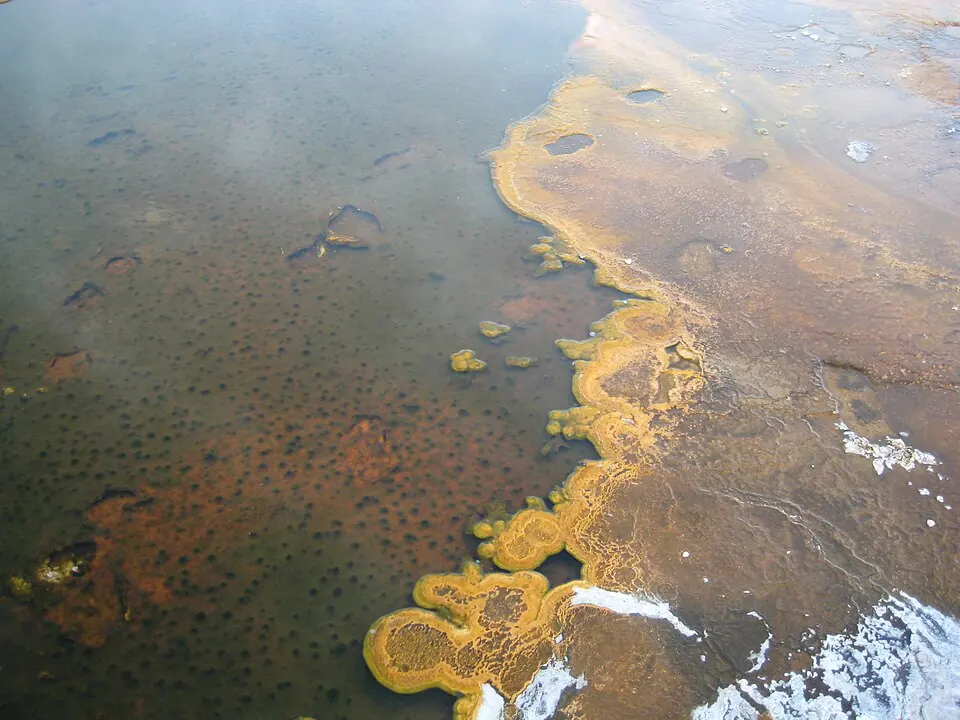
Microbial mats, thin sheets of microbes, grew on river banks in what is now South Africa about 3.22 billion years ago and are the oldest life on land, long before plants.
The oldest life on land is preserved in the Moodies Group, a series of rock layers in what is now South Africa. Long before plants, microbial mats grew there on the banks and gravel bars of rivers. A few kilometres away, other mats grew on tidal flats, shores that the sea covers at each tide. The nitrogen of the river mats and that of the marine mats differ measurably in isotopic composition, the proportion of heavy and light forms of the element. The difference indicates that the river mats ran a nitrogen cycle distinct from that of the sea: they fixed atmospheric nitrogen, that is, took it from the air, on land and under an atmosphere containing no oxygen. Life on land is therefore at least as old as these rocks.
Why it matters
The colonisation of the continents is ordinarily presented as the history of plants. It began more than two and a half billion years before plants, with microbial mats that bound wet gravel on river banks.
Dating & uncertainty
The argument that the mats of the Moodies Group, in South Africa, lived out of the sea is chemical. The mats that covered the river gravels and the marine mats a few kilometres away have distinct carbon and nitrogen isotope signatures. Life on land earlier than these mats is plausible, but no trace of it is as clear.
Earth history as one day
06:58:4017 h 1 min before midnight
if Earth’s 4.54 billion years were compressed into a single day