LIFE
The Oldest Reef: Built by Microbes
~3.43 billion years ago
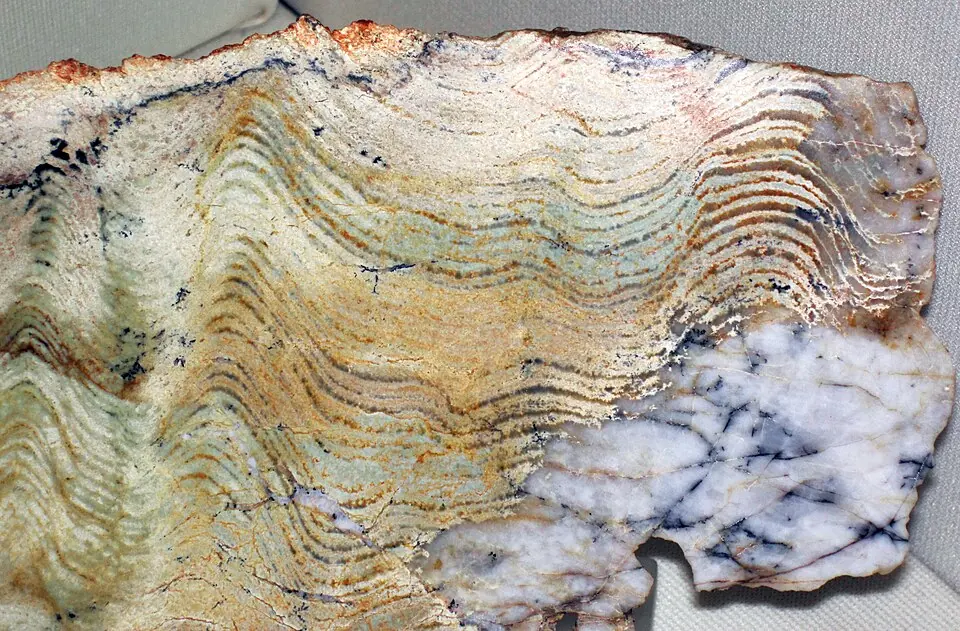
The oldest reef built by life is a platform of carbonate rock in Western Australia, about 3.43 billion years old, where microbial mats, thin sheets of microbes, raised mounds and cones.
The Pilbara reef, in Western Australia, is a carbonate platform, a body of carbonate rock, the family of limestone, several kilometres across. It preserves mounds, cones and wavy sheets raised by microbial mats. A mat builds a mound by trapping and binding sediment: its filaments of microbes hold passing grains, and the mat then grows over them, so that the mound rises grain by grain. Seven distinct shapes recur across the platform. Each shape is confined to its own zone, and the zones are arranged along the ancient shoreline, much as living mats occupy different zones according to water depth. Microbes alone built the Pilbara reef, and it is a reef in the strict sense.
Why it matters
The Pilbara reef preserves an entire ecosystem, and researchers have mapped it zone by zone along the ancient shoreline. It is the oldest available evidence of life already organised into an ecosystem.
Dating & uncertainty
Chemistry alone, without any organism, can also build layered mounds, which is why every claim of life in rocks of this age is contested. For the Pilbara reef, the first argument is scale: seven distinct shapes, each confined to its own zone, across a platform several kilometres wide. In comparable settings throughout the history of the Earth, such a distribution reflects the presence of organisms. Researchers have since examined the mounds under the microscope. They found organic layers, and traces of the original texture that vary with the shape of each mound, which completed the argument.
Earth history as one day
05:52:0418 h 8 min before midnight
if Earth’s 4.54 billion years were compressed into a single day