EARTH × ATMOSPHERE
The Origin of Earth's Water
~4.5 to 4.4 billion years ago (origin debated)
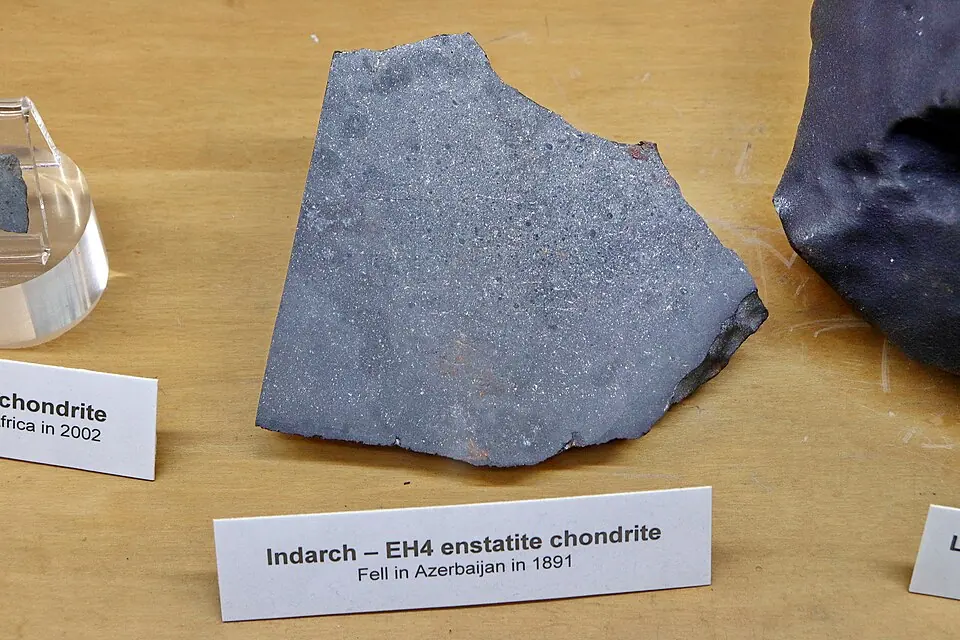
The origin of the ocean's water is not settled, but enstatite chondrites, the meteorites closest to the Earth in composition, contain enough hydrogen to form at least three times the water of the ocean.
The water of the Earth's ocean has two proposed origins, and the question is not settled. In the first account, the water came with the material from which the planet was built and was present from the start. The enstatite chondrites were long taken for dry, because they formed too close to the Sun to retain water. Piani and colleagues (2020) measured them finely and found enough hydrogen, one of the two elements of water, to fill the ocean at least three times over. In the second account, asteroids delivered the water after the planet had formed. The grains brought back from the asteroid Ryugu support this account. They resemble the CI carbonaceous chondrites, a family of carbon-rich meteorites that is exceptionally rich in water. These meteorites are rare on the ground, largely because material that fragile seldom survives the passage through the atmosphere. Asteroids of that kind may be common, and could have delivered the water of the ocean.
Why it matters
If planets form with their water, oceans should be common across the galaxy. If impacts must deliver the water afterwards, an ocean depends on chance. The origin of the Earth's water therefore indicates how many other planets can be expected to have seas.
Dating & uncertaintyDisputed
Each hypothesis rests on an isotopic signature, the proportions in which an element occurs in forms of different mass, called isotopes. Piani and colleagues (2020) found that the hydrogen in enstatite chondrites matches that of the Earth's mantle, its thick layer of rock. Greenwood and colleagues (2022) found that the oxygen of the Ryugu grains comes closest to that of the CI chondrites, bodies formed far from the Sun. Both signatures are convincing, and the measurements no longer distinguish between the two sources.
Earth history as one day
00:28:3223 h 31 min before midnight
if Earth’s 4.54 billion years were compressed into a single day