EARTH
The Giant Impact That Formed the Moon
~4.5–4.4 billion years ago (debated)
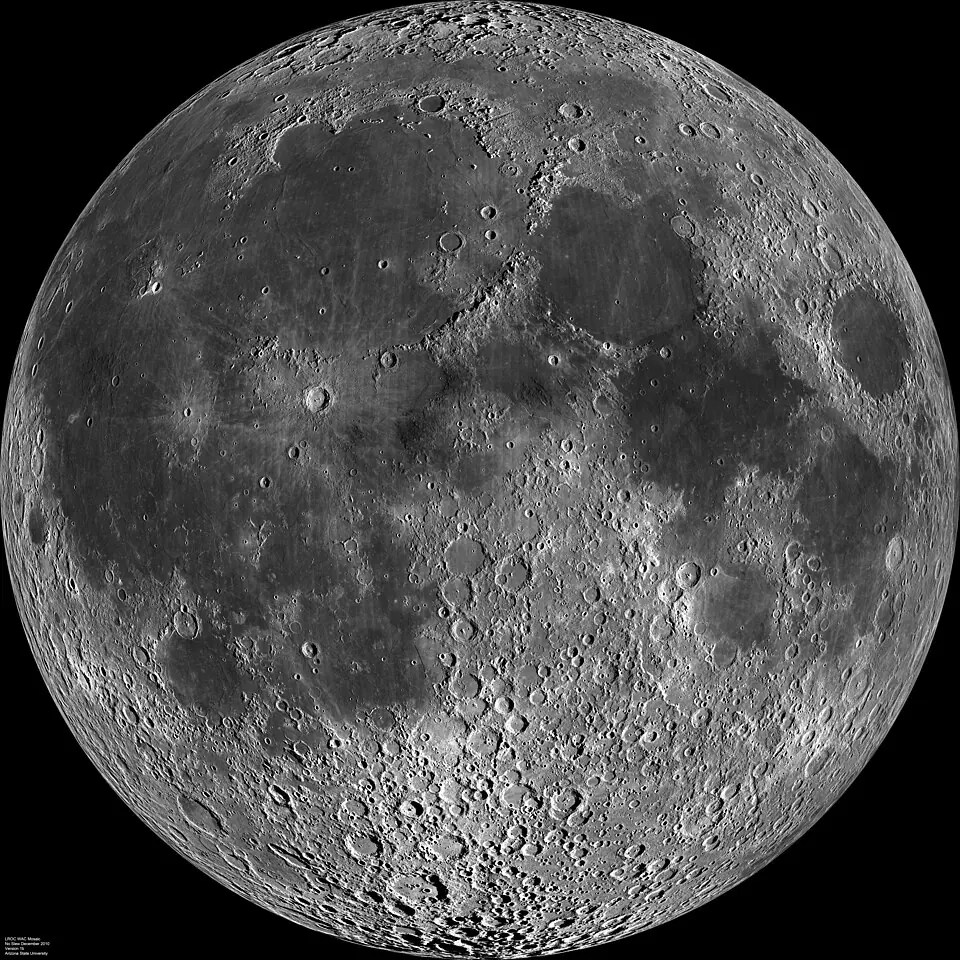
The Moon is thought to have formed from the debris thrown into orbit when a young planet, called Theia, struck the Earth about 4.5 to 4.4 billion years ago, a scenario whose date and details are still debated.
The giant impact hypothesis is the explanation of the Moon's formation by a collision between the Earth and a young planet. According to this hypothesis, the collision threw debris into orbit, and the Moon assembled from that debris. Researchers call the young planet Theia, and the classical version of the hypothesis gives Theia the size of Mars. This version has to account for one observation. Oxygen exists in several forms of different mass, called isotopes. Their proportions in lunar rock are almost indistinguishable from those in the Earth's mantle, the thick layer of rock that surrounds the Earth's core. A planet formed elsewhere in the solar system should have differed markedly from the Earth. Competing versions therefore propose a more massive Theia and a more complete mixing of the two bodies. In every version, the collision left the Earth molten again from surface to depth.
Why it matters
The impact removed whatever surface the Earth had. It gave the Earth a satellite, the Moon, which stabilises the tilt of the planet's axis and generates the tides. The impact was also the last of the giant collisions, and it ended the phase of violent accretion, the growth of the planet by collisions.
Dating & uncertaintyDisputed
The date of the Moon's formation is disputed. The oldest lunar rocks that are securely dated are about 4.35 billion years old. Some authors identify this value with the age of the Moon. Others read it as the late solidification of a magma ocean, a global layer of molten rock on the young Moon, and not as the Moon's formation. Models by Maurice and colleagues (2020) allow that ocean to remain molten for 150 to 200 million years. Schneider and colleagues (2025) measured a strontium clock, a dating method based on radioactive decay, in the oldest lunar crust. Unless Theia had the classical size of Mars, this clock places the formation of the Moon around 4.50 billion years ago.
Earth history as one day
00:19:0123 h 41 min before midnight
if Earth’s 4.54 billion years were compressed into a single day