TECHNOLOGY
The Invention of the Wheel
~5,400 years ago
Neolithic · Neolithic · Holocene · Northgrippian
The wheel and the wheeled vehicle appear almost simultaneously about 5,400 years ago, in several regions of Eurasia, five millennia after the beginnings of farming.
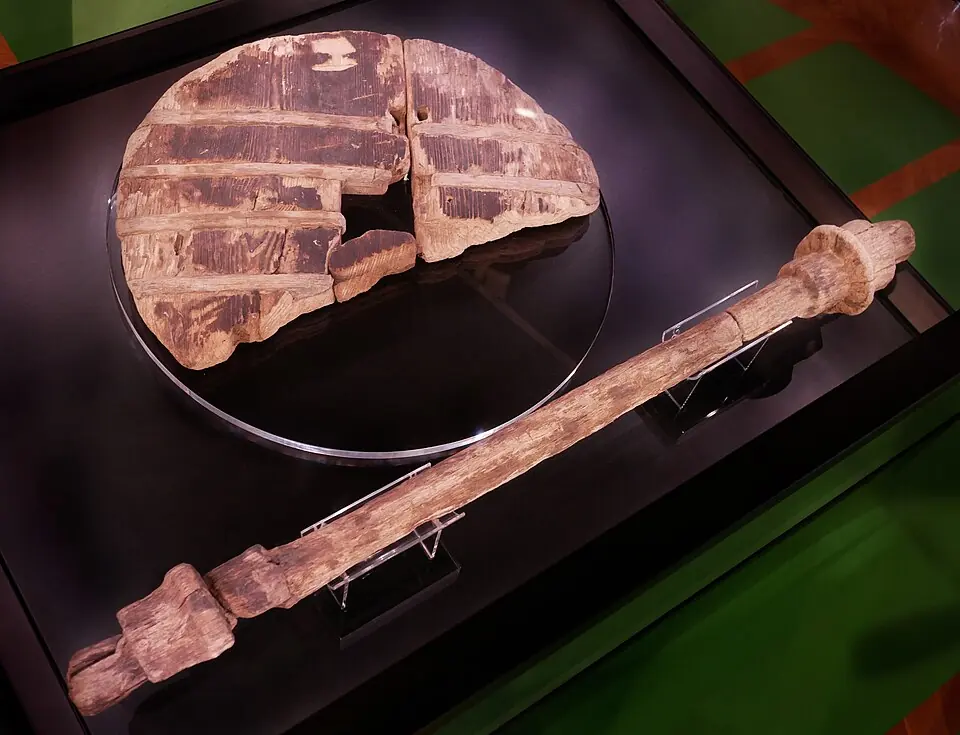
The wheel appears late in the human technical sequence, a hundred thousand years after the first pigment workshops and five thousand years after the beginnings of agriculture. Wheels and draught vehicles appear almost simultaneously, in the middle of the fourth millennium BCE, in the Carpathian basin, on the Pontic steppe and in Mesopotamia, a distribution suggesting that the necessary conditions came together at several points in the same period. Ox-drawn wagons permit the movement of entire households across steppe country.
Why it matters
The technical difficulty lies not in the disc but in the axle: a wheel presupposes a journal and a hub fitted closely enough to bear the load and freely enough to turn without seizing or wearing rapidly, which belongs to precision carpentry. The wheel further depends on the existence of draught animals able to move the loaded vehicle and on practicable terrain, which explains its late appearance and uneven diffusion. Egypt built its pyramids without it, and several American civilisations knew it only in miniature, which contradicts the model of a single obligatory technical succession.
Dating & uncertainty
Wheels and wagons appear almost simultaneously in several regions in the fourth millennium BCE, from the Carpathians to Mesopotamia and the steppe, without any priority being establishable. One hypothesis relates the invention to the copper mines of the Carpathians, where ore carts would have constituted the first application. The model of a single Mesopotamian origin is no longer supported by the data.
Our species’ history as one day
23:35:1824 min 41 s before midnight
if the 315,000 years of Homo sapiens were compressed into a single day