LIFE × EVOLUTION
The Earliest Multicellular Algae
~1.6 billion years ago
Proterozoic · Paleoproterozoic · Statherian
The earliest multicellular organisms, bodies of cells that divided and stayed attached, are known from three fossil finds in North China and central India, in rocks between 1.63 and 1.56 billion years old.
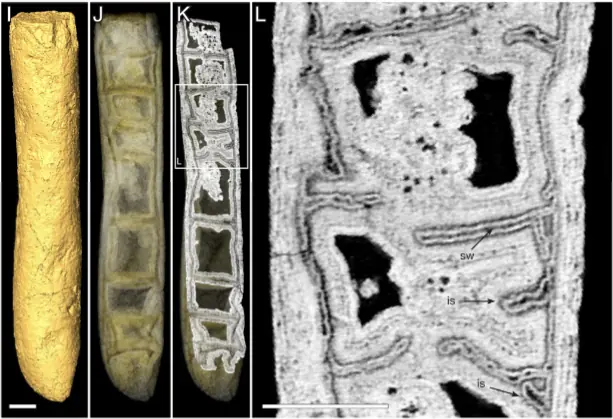
Multicellularity is the condition of cells that divide and remain attached, forming one body. Three separate finds in North China and central India show it in rocks between 1.63 and 1.56 billion years old. One find consists of unbranched filaments whose cells reach nearly a fifth of a millimetre across. Another, from India, consists of probable red algae preserved down to their internal partitions, called septa. The third find is the youngest of the three. It consists of blades, flat leaf-like bodies preserved as films of carbon and large enough to be seen without magnification. All these organisms were composed of many cells held in a single body, and all appear to have been photosynthetic, which means that they lived on the energy of light.
Why it matters
Simple multicellularity is almost as old as the complex cell itself, the cell with a nucleus, called eukaryotic. The oldest of these fossils come from rocks barely younger than those that yielded the first indisputable eukaryotes. A billion years then elapsed before animals turned multicellularity into spectacular forms. Adhesion between cells was the easy step, and building an organism out of attached cells the difficult one.
Dating & uncertainty
The three finds are independent of one another and come from rocks between 1.63 and 1.56 billion years old, in North China and India. Researchers assign fossil cells to a modern group on shape, size and mode of preservation. The affinities of these fossils, that is, the living groups to which they are related, are therefore argued case by case. If the Indian fossils are indeed red algae, red algae are some four hundred million years older than the oldest specimen previously accepted.
Earth history as one day
15:22:598 h 37 min before midnight
if Earth’s 4.54 billion years were compressed into a single day