TECHNOLOGY × SOCIETY
Olorgesailie: Stone Carried from Afar
~320,000 years ago
In the Kenyan rift about 320,000 years ago, people were already using stone carried from sources 25 to 50 kilometres away, and working red pigment.
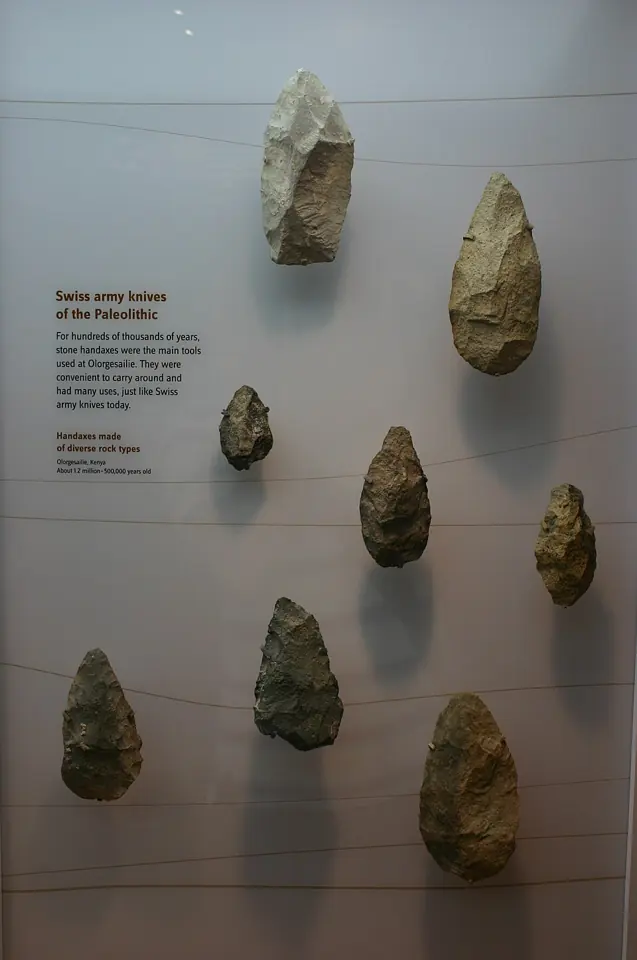
Olorgesailie is a sedimentary basin in the southern Kenya rift, where erosion has exposed a sequence covering more than a million years. In levels dated between about 320,000 and 295,000 years ago, the large handaxes of the Acheulean give way to prepared cores and points, smaller and struck to a plan, which define the Middle Stone Age. Excavation there recovered iron-rich rocks worked for red pigment, and geochemical matching traced part of the toolstone, obsidian among it, to outcrops lying 25 to 50 kilometres away and further. Two independent clocks fix the sequence: argon-argon dating of the volcanic ash, and uranium-series dating of the deposits. Late Acheulean assemblages run from 615,000 to 499,000 years ago, after which a Middle Stone Age with no Acheulean elements sets in, most probably by 320,000 years ago and at the latest by 305,000.
Why it matters
Stone from 25 to 50 kilometres away did not reach the camp on its own. Two readings follow, and the excavated material does not choose between them: either the group travelled to the outcrops, which means a range far wider than the ground it camped on, or the stone passed between groups, which would make these levels the earliest trace of exchange. The date carries as much weight as the distance, since earlier work had placed the roots of such behaviour after 200,000 years ago, and these levels fall within the span in which the origin of Homo sapiens is set.
Dating & uncertainty
The chronology rests on argon dating of volcanic ash and on uranium-series measurements in the deposits, not on the tools. Those methods place a Middle Stone Age free of Acheulean elements most probably at 320,000 years ago, at the latest at 305,000, and bracket the artefact levels between 320,000 and at least 295,000. The looser reading costs some twenty-five thousand years and not the finding: at either bound, transported stone and worked pigment stand well before the 200,000-year threshold formerly given for such practices.
Our species’ history as one day
00:00:0024 h before midnight
if the 315,000 years of Homo sapiens were compressed into a single day